Wire and Spiral Binding
This article will teach you about the process of creating wire and spiral binding. Read on to expand your knowledge about this type of binding!
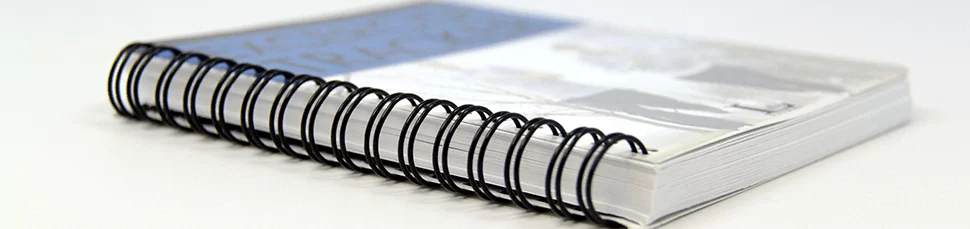
For the process of creating wire or spiral binding, the book block is first trimmed on all four sides. Then, holes are drilled along one side and the pages are secured by either a wire that is clamped through the holes or a spiral that is threaded through the holes.
Because projects using this type of binding do not have to be stapled or sewn through the fold, they do not follow the standard page count multiple of 4 rule. Instead your final page count can be an increment of 2. That is great news if you have a project that has a page count that isn’t a multiple of 4!
This type of binding is most often used for calendars, cookbooks, and activity/workbooks. For all of these types of projects, the wire and spiral binding makes it possible for them to lay flat when open against a surface like a desk, floor, or wall. If you’re printing a project like this, then wire binding might be the right type of binding for you.
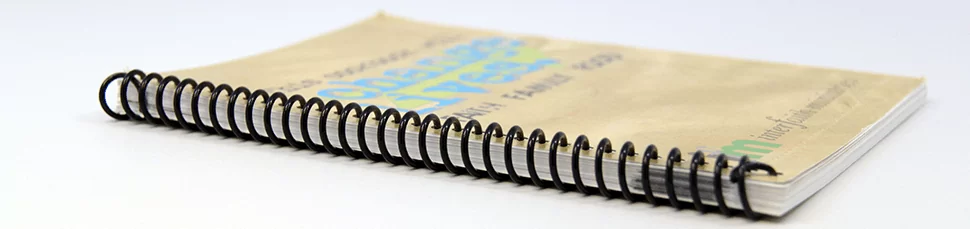
Wire-O vs. Spiral: What’s the Difference?
These two binding methods look similar but are structurally distinct:
| Feature | Wire-O (Twin Loop) | Spiral (Coil) |
|---|---|---|
| Structure | Double loops of wire crimped through rectangular holes | Single continuous coil threaded through round holes |
| Page rotation | Opens flat (180°) but pages cannot rotate fully | Pages rotate 360° around the spine |
| Durability | Higher — wire maintains shape under stress | Moderate — coils can stretch or snag over time |
| Page count range | Up to ~200 pages | Up to ~300+ pages |
| Best for | Calendars, planners, reports, cookbooks | Workbooks, notebooks, manuals, educational materials |
Wire-O binding — also called twin loop or double loop wire — was popularized by the James Burn International company, which developed the first commercial wire binding machines. The wire is manufactured from low-carbon steel or galvanized steel and is available in diameters from 1/4″ (6.4 mm) to 1-1/4″ (31.8 mm), with pitch options of 3:1 (three holes per inch — standard for most books) or 2:1 (two holes per inch — used for thicker documents).
Spiral binding uses a single continuous coil — typically made from PVC-coated steel or nylon — that is threaded through round holes along the binding edge. The coil diameter ranges from 6 mm to 50 mm depending on page count and paper weight.
How Wire and Spiral Binding Are Manufactured
The manufacturing process involves three stages:
1. Punching — Holes are punched along the binding edge using a die that matches the wire or coil pitch. Wire-O uses rectangular (square) holes; spiral uses round holes. Industrial punching machines can process stacks of up to 20 sheets at a time.
2. Binding — For Wire-O, pre-formed wire segments are placed through the holes and crimped shut with a closing machine. For spiral, the coil is rotated through the holes using a coil inserter — either manually or with automated equipment that can bind up to 500 books per hour.
3. Trimming — Excess coil is cut and the ends are crimped (for spiral) to prevent the coil from unthreading. Some manufacturers apply heat to the cut coil ends to create a smooth, rounded finish.
Material Options
Wire Colors and Finishes
Wire-O binding wire is available in a wide range of colors and metallic finishes. Standard options include black, white, silver, and gold. Nylon-coated wire adds color options like red, blue, and green while also improving corrosion resistance — important for products that will be used in humid environments or handled frequently.
Paper Considerations
Because wire and spiral bound books lay flat, the paper weight and coating become especially important for usability:
- Uncoated 70–80 lb text — Best for workbooks and journals where users need to write on the pages
- Coated 80–100 lb text — Best for cookbooks and photo-heavy reference books where color reproduction matters
- Card stock covers (10–14 pt) — Recommended for front and back covers to protect the interior pages and add rigidity
Industry Standards
Binding quality and durability are governed by several standards:
- ISO 11800:1998 — The international standard for book binding requirements, covering materials, methods, and durability classifications for all commercial binding types including mechanical (wire/spiral) binding.
- BMI MSST — The Book Manufacturers’ Institute’s Manufacturing Standards and Specifications for Textbooks, the primary U.S. reference for binding materials, tolerances, and testing procedures.
- ASTM D4279 — Standard test methods for evaluating commercial binding quality, including page pull strength and hinge durability.
For wire binding specifically, wire diameter and tensile strength are typically specified according to ASTM A853, which covers steel wire for mechanical springs and binding applications.
When to Choose Wire or Spiral Binding
Wire and spiral binding are ideal when your project needs to:
- Lay completely flat on a surface (cookbooks, sheet music, repair manuals)
- Stay open hands-free (recipe books propped on a kitchen counter)
- Have a page count that isn’t a multiple of 4
- Include mixed paper stocks (tabbed dividers, card stock inserts between text pages)
- Hang on a wall (calendars, flip charts)
The main trade-off is that wire and spiral bound books cannot have a printed spine — so they won’t display a title when shelved spine-out. For projects that need both lay-flat functionality and a printable spine, consider lay-flat perfect binding as an alternative.