Mini Style Playing Cards
Want mini style playing cards for your custom board or card game? We can help.
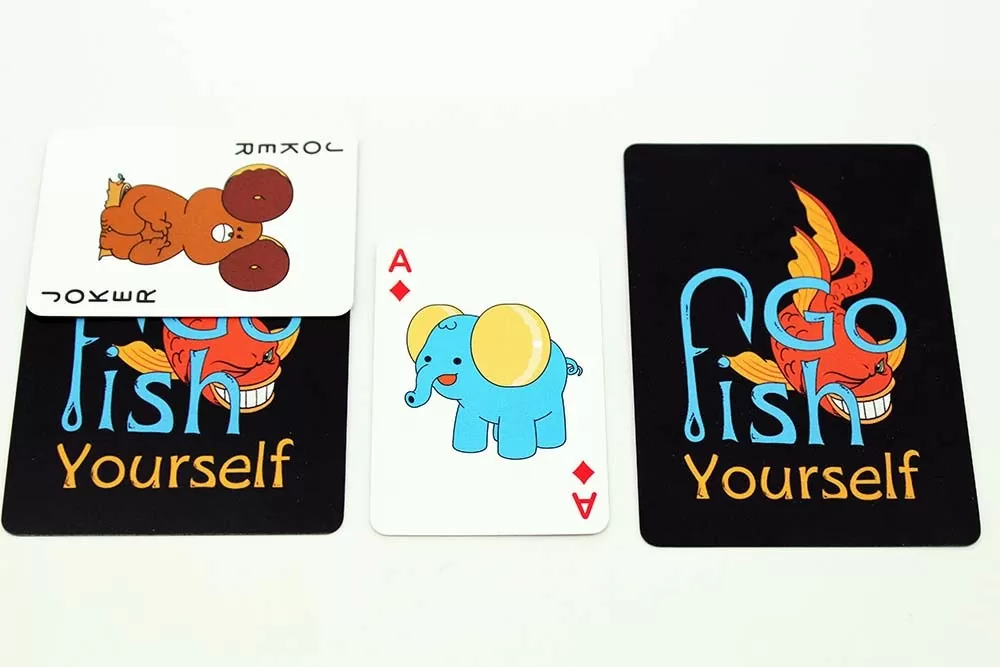
Our mini-sized card die is 1.65″ x 2.5″ — the width of a standard poker card, but roughly half the height. It’s a compact format with a surprising range of uses.
Why Choose Mini Cards?
Mini-sized cards can be beneficial to your game in a variety of ways:
- The smaller size is easier for kids to handle.
- They are extremely portable — ideal for traveling.
- Brands can give away mini decks as an easy gift to build customer loyalty.
- They are great to sell for fundraisers, give away as party favors or other special event mementos.
- Some board games may need a variety of card sizes to distinguish between game features, like Monopoly’s Chance cards.
- Mini decks work well as add-on components in board games where cards serve a secondary role (drawing events, tracking resources).
We’re sure there are many more ways to use mini cards — we can’t wait to see what you come up with!
Standard Playing Card Sizes
The modern playing card size system was largely established by the United States Playing Card Company (USPCC), which began mass production in 1881 and created the Bicycle brand in 1885. These dimensions became the global industry standard and are now maintained by Cartamundi, who acquired USPCC in 2019.
| Size | Inches | Metric | Common Use |
|---|---|---|---|
| Mini | 1.75 x 2.5 | 44 x 63 mm | Travel games, promos, children’s games |
| Bridge | 2.25 x 3.5 | 56 x 87 mm | Bridge, trick-taking games with large hands |
| Poker | 2.5 x 3.5 | 63 x 88 mm | Most card games, poker, custom games |
| Tarot | 2.75 x 4.75 | 70 x 121 mm | Tarot decks, games with detailed artwork |
The poker size closely corresponds to the ISO 216 B8 paper format (62 x 88 mm). While there’s no dedicated ISO standard for playing cards specifically, the USPCC/Cartamundi dimensions are the accepted industry convention worldwide.
Card Stock and Quality Grades
Playing card stock is a laminated sandwich: two paper sheets bonded with an opaque adhesive core layer. The core prevents players from seeing through the card — an important consideration for any competitive game.
Blue core (280–300 GSM) is the most common card stock on the market. The blue-tinted adhesive core blocks 90–95% of light, which is more than adequate for casual play. Blue core stock offers good “snap” — the ability to spring back to shape after bending — at a cost-effective price point.
Black core (310–330 GSM) is the casino and competitive-play standard. The black adhesive core provides complete opacity, and the heavier weight gives a crisper, more substantial feel. When manufacturers or reviewers describe cards as “casino quality,” they typically mean black core stock with a linen or air-cushion finish.
Standard card thickness runs 0.3–0.35 mm (12–14 pt), with a typical corner radius of 3–3.5 mm (1/8″).
Safety Standards for Children’s Card Games
If your card game is designed for or marketed to children, there are important regulatory requirements to be aware of:
United States — CPSIA and ASTM F963
The Consumer Product Safety Improvement Act (CPSIA) applies to all children’s products designed for ages 12 and under. It sets lead limits at 100 ppm in substrates and 90 ppm in surface coatings, and requires third-party testing by a CPSC-accredited laboratory.
ASTM F963-23 is the mandatory toy safety standard covering mechanical, physical, chemical, and flammability hazards. For paper-based card games printed with conventional CMYK inks, the CPSC has determined that these materials generally don’t exceed lead limits — so third-party lead testing may not be required. However, if your game includes non-paper components (plastic tokens, metal pieces, dice), those components will need full testing.
Any game with small parts intended for children ages 3–6 must carry a choking hazard warning per 16 CFR 1501.
European Union — EN 71
Card games sold as toys in the EU must comply with the EN 71 standard series, which is harmonized with the EU Toy Safety Directive 2009/48/EC. Key parts include:
- EN 71-1: Mechanical and physical properties (sharp edges, small parts)
- EN 71-2: Flammability characteristics
- EN 71-3: Migration of certain elements — tests for heavy metals (lead, cadmium, mercury) that could leach from printed surfaces
Compliant products carry the CE marking. Note: the EU’s new Toy Safety Regulation (EU) 2025/2509, applicable from August 2030, will introduce a Digital Product Passport requirement with a QR code linking to safety and compliance data.
Industry Resources
If you’re developing a card game, these organizations and resources are worth knowing about:
- Game Manufacturers Association (GAMA) — The non-profit trade association for the tabletop game industry since 1977. Runs GAMA Expo (trade show) and Origins Game Fair.
- The Toy Association (TIA) — Represents ~90% of U.S. domestic toy sales. Active in safety advocacy and CPSIA/ASTM standards development.
- CPSC Toy Safety Business Guidance — The Consumer Product Safety Commission’s official guide for toy manufacturers and importers.
If you’re interested in reading more about custom game printing, be sure to check out our custom board game hub and our custom card game hub. These parts of our site contain all the information you need to know about creating a board game or a card game — beyond just the standards listed here, these hubs also contain detailed information on all the types of materials and packaging types we offer for your game.