Edge Printing – Sprayed Edges
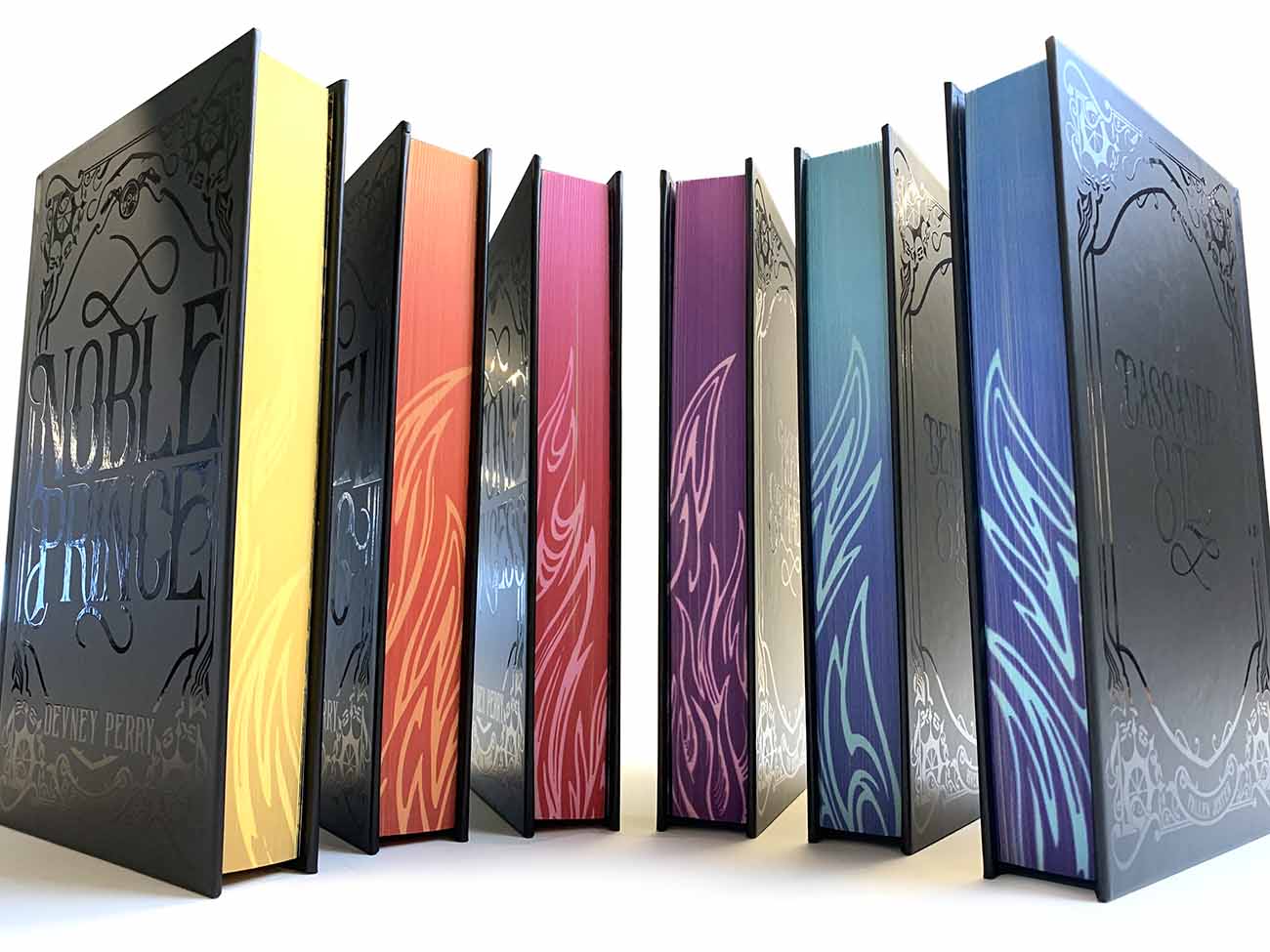
Want to really make your project stand out from the rest? Edge printing may be the answer for you. Edge printed (or sprayed edge) designs are printed directly onto the trimmed edges of your project’s book block before the binding process. Each trimmed side can be unique and tell a whole story on its own!
A Centuries-Old Art Form
Decorating book edges is one of the oldest traditions in bookmaking. Edge gilding — applying gold leaf to trimmed page edges — dates back centuries and was originally used as much for preservation (sealing out dust and moisture) as for aesthetics.
The most celebrated technique is fore-edge painting: watercolor scenes painted on fanned page edges that disappear under gilding when the book is closed. The earliest known example dates to 1649, with the technique reaching its peak between 1785 and 1835 through the work of the Edwards of Halifax family of bookbinders. Today, the largest American collection of fore-edge paintings — 709 volumes — resides in the Ralph H. Wark Collection at the College of William and Mary.
Other historical edge decoration techniques include:
- Sprinkled edges — Pigment flicked onto edges with a stiff brush; the most common and affordable decoration from the 1600s onward
- Marbled edges — Swirled multi-color patterns transferred from floating pigments on a sizing bath, originating in Asia and reaching Europe in the 15th century
- Gauffered edges — Gilded edges further decorated by impressing heated finishing tools into the surface, especially associated with 16th-century German bookbinding
The RIT Cary Graphic Arts Collection mounted an “Edges of Books” exhibition showcasing many of these techniques, and Princeton University Library maintains a digital exhibit on edge decoration in hand bookbinding. For those interested in the craft, the Guild of Book Workers publishes detailed standards handouts including Peter Geraty’s reference guide on edge decoration techniques.
Modern Edge Printing Techniques
Today, there are two main methods for printing on book edges:
Digital Edge Printing
Multiple book blocks are clamped together in a stack and run through a belt-fed digital edge printer. A UV inkjet printhead sprays the design directly onto the book edges, and the UV LED-cured ink dries instantly — which is critical, because wet ink would glue the pages together. Digital printing supports full CMYK color, making photographic-quality designs possible on all three trimmed edges.
Screen Printing
Ink is pushed through a mesh screen onto the clamped book block edge. The key difference from digital: screen printing applies ink thicker, resulting in brighter, more saturated color. It also supports specialty inks like metallics — specified as Pantone Solid Coated spot colors. Screen printing works best for bold, flat-color designs rather than photographic images.
Artwork requirements for screen printing:
- Supply artwork in vector format (Adobe Illustrator .ai, .eps, or .pdf)
- Convert all fonts to outlines/curves
- Minimum 1pt line thickness
- Specify each color as a Pantone Solid Coated (C) swatch
- Separate layers for each color, clearly named (e.g., “Red — Pantone 186C”)
The Special Edition Boom
Edge-decorated books have seen an explosion in popularity, driven by book subscription boxes like FairyLoot, Illumicrate, OwlCrate, and LitJoy Crate. These services release limited special editions featuring sprayed edges, stenciled fore-edge designs, exclusive covers, and author signatures — commanding significant premiums on the secondary market.
This trend represents a real opportunity for independent publishers and self-published authors. A sprayed or printed edge treatment transforms a standard book into a collectible object, and readers increasingly expect (and seek out) these premium touches.
Manufacturing Requirements
There are some important manufacturing limitations to be mindful of:
- Edge printing is limited to perfect bound and casebound projects.
- The book block itself must be at least .40″ thick to provide enough surface area for a printable edge.
- Specialty inks (metallic ink, for example) are only available for screen printing, not digital printing.
The Book Manufacturers’ Institute (BMI) publishes the MSST (Manufacturing Standards and Specifications for Textbooks), which is the primary U.S. industry reference for binding materials and tolerances. The international equivalent is ISO 11800:1998, which covers requirements for binding methods and materials including edge stain quality — specifying no feathering and consistent color from volume to volume.
How Do I Know If My Book Block is .40″ Thick?
Just go ahead and save a quote via our instant online calculator. Once you receive your emailed quote PDF, reach out to customer service with your PRN# and ask:
“I would like to know if my project allows for digitally printed edges?”
Artwork Setup
For digitally printed edges:
Reach out to your Account Manager or Customer Service with your project’s PRN# and ask for the required artwork size. Each edge gets its own separate file, with 3mm bleeds on all sides, in CMYK color mode.
For screen printed edges:
Same process — reach out with your PRN# and ask for the required artwork size. Additionally, artwork for screen printing should be supplied in vector format and the design itself should be a spot color.