Collation/Sorting
The collation process starts with parent sheets being folded into signatures.
Parent sheets are large pre-cut pieces of paper, typically designed to fit 4-16 pages of a project on each side or 55 poker cards. They come in many weights and are often pre-coated with gloss or matte coating. One of the major factors in the cost of a printing project is how many parent sheets will be used, which is why certain standard sizes (8.5″x11″, 6″x9″, 9″x12″) and page counts (multiples of 16) are usually the most cost-effective choices since they can maximize the parent sheets used.
The Folding Process
Once the printing is complete, the stacks of fully-printed and dried parent sheets are taken to be folded by the folding machine. Each parent sheet zooms through the machine one at a time entering into gates that are set to the proper fold size. A final fold is applied by a heavy arm, called the knife fold, that applies pressure on the fold line. The final project rolls out of the machine as a signature. The majority of projects are folded by these machines, although extremely large projects or those with unique requirements may occasionally be folded by hand.
Types of Folds
The fold configuration determines how many pages fit on each parent sheet and how they’ll read in sequence:
| Fold Type | Pages per Sheet | Common Name | Use |
|---|---|---|---|
| Single fold | 4 (2 per side) | Folio | Saddle-stitched booklets, newsletters |
| Double fold | 8 (4 per side) | Quarto | Small-format books, signatures for thicker projects |
| Triple fold | 16 (8 per side) | Octavo | The most common signature size for trade books |
| Quadruple fold | 32 (16 per side) | Sextodecimo | Large-format presses, high-volume runs |
These naming conventions — folio, quarto, octavo — date back to the earliest days of printing. When Gutenberg printed his Bible in the 1450s, each sheet of parchment was folded once (folio), yielding two leaves (four pages). The terms are still used today in bibliographic description and by the Book Manufacturers’ Institute (BMI) in their MSST specifications.
Imposition: Planning the Layout
Before any folding happens, the pages must be arranged on the parent sheet in the correct positions so that they’ll read in the right order after folding. This arrangement is called imposition — and it’s one of the most critical steps in prepress production.
Imposition software (such as Kodak Preps or Heidelberg MetaDimension) calculates the correct page positions, rotations, and margins automatically. The key variables are:
- Creep — In saddle-stitched booklets, inner pages extend slightly past outer pages when folded. Imposition software compensates by progressively shifting inner pages inward — a process called shingling. Per ISO 12647-2, creep allowance should be calculated based on paper thickness and total page count.
- Lip — The untrimmed edge of the signature that the collating machine grips to pull signatures into position. Typically 10–15 mm wide.
- Crossover alignment — When images or backgrounds span across two pages of a spread, imposition must ensure the halves align precisely after folding and trimming.
Collation: Assembling the Book Block
There may be 1 or dozens of folded signatures that have to be gathered and bound for the final product. Once all the folding is complete the signatures are sent along for collation.
The collator stacks the signatures into the appropriate page order, and they are prepared for final binding. Based on your binding method, this will be either stapled (saddle stitching) or sewn (smyth sewing for perfect binding and case binding). The resulting new stack of ordered signatures is now called the book blocks.
How Collation Machines Work
A modern collation machine (also called a gathering machine) is essentially a long conveyor system with a series of stations — one for each signature. Each station holds a stack of identical signatures. As the conveyor moves, a suction head or friction feeder pulls one signature from each station and drops it onto the growing stack. By the end of the line, a complete book block has been assembled in page order.
Watch the Collation machine stack signatures in page order to make book blocks.
Collation machines like the one pictured below are large enough to handle books with many hundreds of pages, but books with only two or three signatures can also be collated by hand.
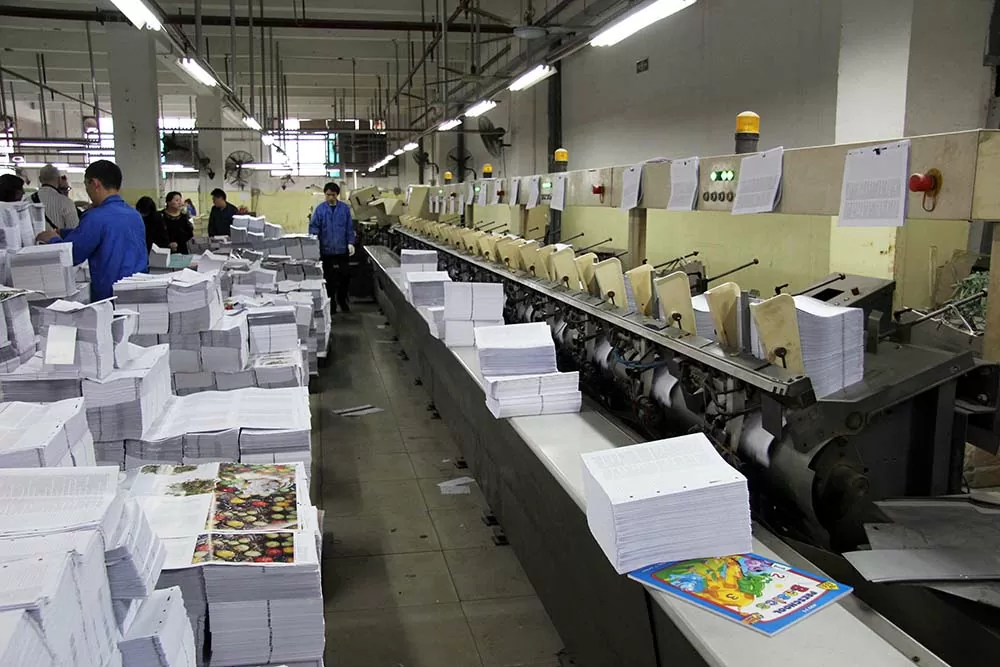
High-speed gathering lines can collate up to 18,000 book blocks per hour. Each station includes a double-sheet detector — a sensor (usually ultrasonic or caliper-based) that rejects any station pull containing two signatures stuck together. This prevents the most common collation error: duplicated sections in the finished book.
Quality Control in Collation
Collation errors — missing signatures, duplicated signatures, or signatures in the wrong order — are among the most costly mistakes in book manufacturing because they aren’t discovered until the book is bound and trimmed.
Modern quality control uses several methods:
- Collation marks (spine marks) — Small black rectangles printed on the spine fold of each signature, stepping down progressively. When a book block is assembled correctly, the marks form a staircase pattern on the spine. A missing or out-of-order signature breaks the pattern and is immediately visible. This is one of the standard printer’s marks included in imposition.
- Electronic signature verification — Camera systems read barcodes or signature numbers printed in the trim area, verifying page order automatically.
- Weight checking — Each completed book block is weighed. A block that’s too light (missing signature) or too heavy (doubled signature) is ejected from the line.
The BMI MSST specification sets the acceptable defect rate for collation at less than 0.1% — meaning fewer than 1 in 1,000 book blocks should contain a collation error. ISO 11800:1998 (requirements for binding of books, periodicals, and serials) includes collation accuracy as part of its binding quality requirements.
From Book Block to Bound Book
After collation, the book block moves to the binding line. What happens next depends on the binding method:
| Binding Method | What Happens After Collation |
|---|---|
| Saddle stitch | Signatures are nested (not stacked) and stapled through the spine fold |
| Perfect binding | Spine edge is milled (roughened), adhesive is applied, and the cover is wrapped around |
| Case binding | Signatures are Smyth-sewn, end sheets are tipped on, and the block is cased into a hardcover |
The entire post-press workflow — folding, collation, binding, and trimming — is collectively known as finishing or bindery operations. In a modern plant, these steps often run as a continuous inline process, with the folding machine feeding directly into the collator, which feeds into the binding line.