Foil Stock
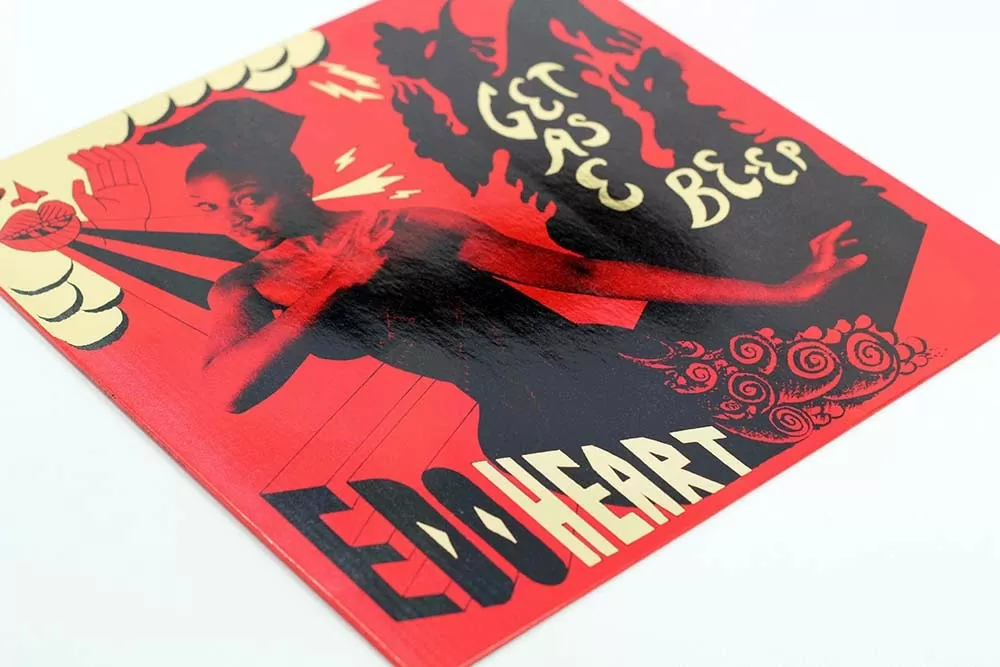
Foil stock, not to be confused with foil stamping, is a paper option that allows your entire cover to be made of foil. Foil stock comes in a silver base, and UV inks are used in the print process to create shiny metallic colors of near-infinite variety.
The album cover to the right is made from gold foil stock with red and black ink printed over the foil. Instead of highlighting one element with foil stamping, such as the title of their album, Edoheart wanted to emphasize the entire cover with a bright and reflective foil stock. This is a great option if you want your whole cover to be highlighted.
How Foil Stock Is Made
Foil stock is a metallized paper — meaning the metallic surface is part of the substrate itself, not a secondary finish applied after printing. There are two primary manufacturing methods:
Vacuum metallization is the most common. The paper is first coated with a base varnish to seal pores and create a smooth surface. It then passes through a vacuum chamber where aluminum wire is heated until it vaporizes. The aluminum condenses onto the paper web in a layer just 20–30 nanometers thick — roughly 1/3,000th the width of a human hair. The process runs at speeds up to 1,000 meters per minute, according to equipment manufacturer BOBST.
Transfer metallization is a newer, more environmentally friendly process. A carrier film is metallized first, then brought into contact with adhesive-coated paper. The aluminum transfers from the film to the paper only where adhesive is present, and the carrier film is stripped away and reused. Transfer metallization uses less than 1% of the aluminum of traditional foil laminate, making it significantly more recyclable. Hazen Paper Company’s Envirofoil is one well-known example of this technique.
Foil Stock vs. Foil Stamping vs. Metallic Ink
These three options all create metallic effects, but they work very differently:
Foil stock is a metallized substrate — you’re printing on a metallic surface with conventional or UV inks. The entire sheet starts metallic, and ink is applied to create your design. Unprinted areas remain shiny. This gives the most dramatic, full-coverage metallic effect.
Foil stamping is a secondary finishing operation. A heated die presses a thin foil carrier onto an already-printed sheet — only the die area receives the metallic effect. It’s ideal for highlighting specific elements like titles or logos, but it requires a custom die and adds cost per impression.
Metallic ink is a standard printing ink containing fine metal particles (aluminum flake for silver, bronze or copper for gold). It produces a softer shimmer rather than a mirror finish and is applied using standard offset or digital presses — no special substrate or die required.
Quick Comparison
| Feature | Foil Stock | Foil Stamping | Metallic Ink |
|---|---|---|---|
| Coverage | Full surface | Selected areas only | Anywhere ink goes |
| Reflectivity | High mirror finish | High mirror finish | Soft shimmer |
| Custom die required? | No | Yes | No |
| Works with CMYK overprint? | Yes (UV inks) | No | Limited |
| Best for | Full-cover metallic effect | Accent elements | Subtle metallic tones |
Technical Considerations for Printing on Foil Stock
Because foil stock is a non-porous substrate, inks cure on the surface rather than absorbing into the paper. This means UV-curable inks are the standard choice — they dry instantly under UV light and adhere well to the metallic surface.
For reliable adhesion, the surface energy of the metallized paper needs to be at least 38 dyne/cm. If adhesion is a concern, corona or plasma treatment can raise the surface energy before printing. According to specialty ink manufacturer Cork Industries, inadequate UV cure is the number-one cause of adhesion failure on metallized substrates.
For color management, the relevant industry standard is ISO 12647-9:2021 — the ISO specification for offset printing on metal decoration substrates. Gloss measurement on metallized surfaces follows TAPPI T 480, which measures specular gloss at 75 degrees.
Popular Foil Stock Options
Several paper mills produce metallized stocks suitable for cover printing:
- Curious Metallics (Arjowiggins, now distributed by Mohawk) — 100% sulphite, FSC-certified mica-coated sheets available in dozens of colors. The mica crystals reflect light at multiple angles, creating a more textured metallic effect. Compatible with offset, embossing, foil stamping, and inkjet.
- Envirofoil (Hazen Paper) — Transfer-metallized with an aluminum layer just 300 angstroms thick. Achieved a 19/20 recyclability score from Interseroh’s “Made for Recycling” certification and is certified under Italy’s Aticelca 501 standard as recyclable with paper.
Environmental Considerations
Traditional foil-laminated paper bonds aluminum foil or metallized film with a plastic carrier to paper. During recycling, the metal and plastic layers don’t break down in repulping, which can contaminate recycled fiber. Over 94% of U.S. curbside programs prohibit metallized or foil-coated paper.
Transfer-metallized products are changing this. Because the aluminum layer is so thin — less than 1% of a traditional foil laminate — testing has shown that even 80% foil coverage does not affect repulpability. If environmental sustainability is important to your project, ask about transfer-metallized stock options.
Pricing
Request pricing for this add-on while locking in your price on our quoting calculator. Not sure if foil stock is the right option for you? Stuck between this option, foil stamping, and metallic ink? Feel free to contact us and we can help you make a decision.