Accordion Books
What are accordion books?
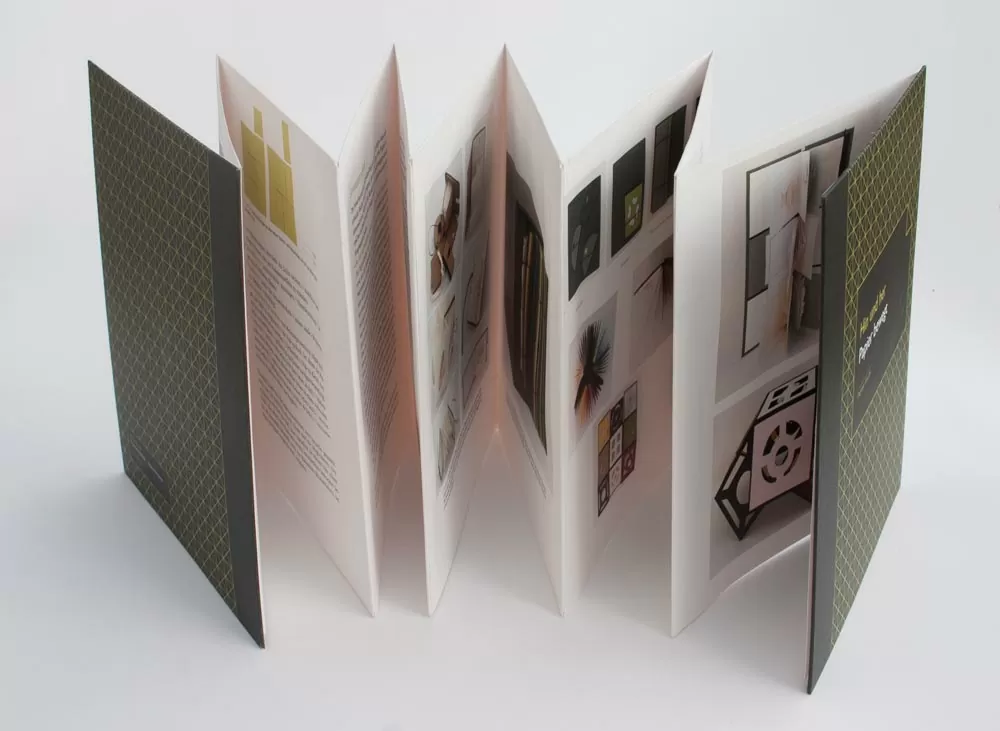
Multifold Book With Hardcovers
Although we love a good old-fashioned smyth-sewn book, we certainly aren’t limited to printing books with traditional turned pages. As the name suggests, accordion-style books (also known as leporello books) involve printing on an elongated piece of paper that is then folded into an accordion-style pleat. The folds alternate between the front and back so the paper stacks nicely on top of itself in its folded state.
A Format with Deep Roots
The accordion fold is one of the oldest book structures in the world. It predates the Western codex (bound book) by centuries — Chinese concertina books (jīngzhé zhuāng) appeared during the Tang Dynasty (618–907 CE) as a way to store Buddhist sutras, and the format spread to Japan (orihon) and Korea. In Mesoamerica, the Maya created accordion-folded bark paper books called codices (only four survive today, the oldest dating to the 13th century).
The European name leporello comes from the servant character in Mozart’s opera Don Giovanni (1787), who unfolds a long list of his master’s conquests in accordion fashion. The term is still used in European printing and publishing — particularly in Germany and Italy — as a synonym for accordion-fold books and brochures.
Today, accordion books are used for art books, children’s books, photography portfolios, museum catalogs, wedding albums, and game components. The format’s defining feature — an unbroken, continuous surface — makes it uniquely suited to panoramic illustrations, timelines, and designs that flow across multiple panels.
Recommended Material
All of those folds make this style of book more vulnerable than our traditional book bindings, so if you are planning to use this binding for a standalone book project (rather than as a component in a board or card game), we recommend using thicker paper like 10 pt. or 12 pt. cover stock. This ensures the book will be both sturdy and flexible.
Paper Stock Options
| Stock | Thickness | Best For | Fold Quality |
|---|---|---|---|
| 80–100 lb text (coated) | ~0.004″–0.006″ | Multi-panel brochures, game components | Folds easily; may show wear at creases over time |
| 10 pt cover stock | 0.010″ (0.254 mm) | Standalone accordion books — the recommended minimum | Good balance of rigidity and flexibility |
| 12 pt cover stock | 0.012″ (0.305 mm) | Premium accordion books, art books | Very rigid panels; must be scored before folding to prevent cracking |
| 14 pt+ cover stock | 0.014″+ (0.356 mm+) | Board-book-style accordion with case covers | Requires deep scoring; feels substantial and premium |
For heavier stocks (12 pt and above), the fold lines must be scored — a crease pressed into the stock with a steel rule die — before folding. Without scoring, the paper fibers will crack along the fold. Scoring depth and direction follow the grain specifications in TAPPI T 411. Cross-grain folds (folding perpendicular to the paper’s grain direction) require deeper scoring and are more prone to cracking.
Restrictions
The minimum order quantity for accordion book projects is 250 units.
There is also a unique size restriction on accordion books: the maximum unfolded size we are able to print is 38″ x 25″.
Panel Count and Size
The number of panels you can fit depends on your closed (folded) size and the maximum unfolded dimension:
| Closed Panel Size | Max Panels (38″ width) | Total Printable Surfaces |
|---|---|---|
| 4″ wide | 9 panels | 18 (front + back) |
| 5″ wide | 7 panels | 14 |
| 6″ wide | 6 panels | 12 |
| 8″ wide | 4 panels | 8 |
For projects that need more panels than a single sheet allows, multiple sheets can be tipped together (glued at the fold) to extend the accordion. This technique is commonly used for long-format art books and timelines.
Special Options
Accordion books aren’t limited to just our standard stocks, either! You can have casebound front and back covers much like a traditional hardcover book, use specialty textured paper, and even have an accordion-style board book. All our standard specialty options—like foil stamping, spot UV, and so on—can also be used with accordion books.
Case-Bound Accordion Books
Adding hardcovers to an accordion book transforms it into a premium format. The first and last panels are adhered to the inside of the case boards (similar to endsheets in a traditional hardcover), while the accordion folds freely in between. This construction protects the folded panels and gives the book a substantial spine for shelf display.
Case-bound accordion books are a popular format for:
- Art and photography books — The panoramic unfolding creates a gallery-like viewing experience
- Wedding and event albums — The continuous surface accommodates timeline-style layouts
- Children’s books — The dramatic unfolding is engaging for young readers
- Museum and exhibition catalogs — Accordion folds can reproduce the spatial flow of a gallery
Accordion Books as Game Components
In the tabletop game world, accordion-folded pieces serve several functions:
- Player screens / GM screens — Multi-panel accordion folds that stand upright to hide information from other players. Common in role-playing games like Dungeons & Dragons.
- Reference guides — Quick-reference rules that unfold to show all game phases at once, eliminating the need to flip through a booklet mid-game.
- Map strips — Narrow accordion folds that reveal terrain or story progression as players advance.
Pricing
This style of binding requires a custom quote. You can request pricing using our contact page. To make sure we can get you an accurate quote, make sure you include the following information:
- Your desired number of units
- Size of each panel of the accordion book, i.e., the “closed size”
- The number of panels or total unfolded size
- Paper stock
- Whether you want a gloss or matte finish (both varnish and lamination options are available)
- Your shipping address and shipping speed
Additionally, let us know if your project has any extra requirements, such as split shipping or specialty options.
Please note that the outside front and back covers, as well as the inside front and back covers, should be included in the total panel count when requesting a quote.
File Setup Guide
You can find a setup guide for accordion books here.
Visual Guide
More of a visual learner? Check out our visual guide below for a video walkthrough of Accordion Book Basics.