Printing Options
What kind of printing options are available to you?
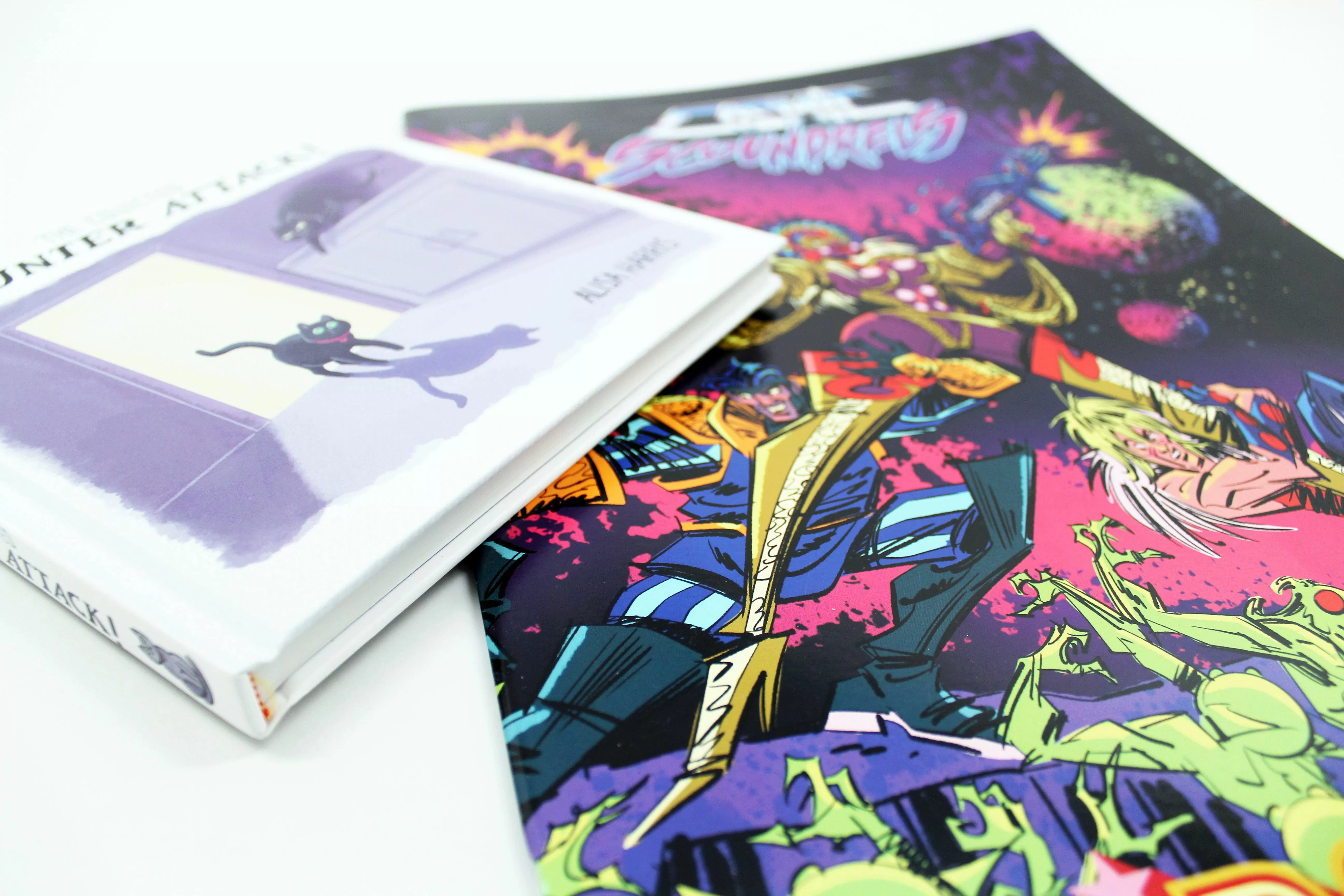
Custom Printing and Binding Options
The first step after deciding to print your own project is to figure out how you want the final product to look and feel. Even on simple jobs the number of offset printing services and options that PrintNinja offers can quickly become overwhelming – but don’t fret!
Thankfully, we’re here to explain everything and make sure your project turns out exactly the way you envision it. PrintNinja offers a multitude of printing options ranging from different paper thicknesses, materials, and additional specialty options – like spot UV, foil stamping, embossing and debossing, and matte varnish – to give your project a little extra flair. Here, you’ll learn more about all of the choices available to you – whether you’re printing a book project or a custom card or board game, we provide choices that will make your final project look amazing. Read on to see all the variety of options and figure out what the best combination is for your printed project.
Select one of the following information pages for more detail, what your options are, and how they’ll impact the end product.


Understanding Your Printing Options
Every printed project — whether it’s a novel, a children’s book, a board game, or a deck of custom playing cards — is defined by a handful of core decisions. Here’s a high-level overview of what you’ll be choosing between:
Paper and Card Stock
Paper is specified by weight (measured in pounds or GSM) and coating (coated vs. uncoated). Heavier paper feels more substantial and resists show-through; coated paper produces sharper images with more vibrant color.
| Paper Type | Weight Range | Best For |
|---|---|---|
| Text stock (uncoated) | 50–80 lb (74–118 gsm) | Novel interiors, workbooks, journals — anything you write on |
| Text stock (coated) | 55–100 lb (80–148 gsm) | Art books, photo books, comics, magazines — vibrant color reproduction |
| Cover stock | 10–14 pt (0.25–0.36 mm) | Book covers, postcards, business cards — structural rigidity |
| Card stock | 280–330 gsm | Playing cards, game cards — opacity and snap |
Paper weight in the U.S. is measured in the basis weight system (pounds per 500 sheets at the paper’s basis size), while the rest of the world uses GSM (grams per square meter) per ISO 536:2019. The two systems don’t convert directly because basis sizes differ by paper grade — which is why 80 lb text and 80 lb cover are very different thicknesses.
Binding Methods
Your binding choice determines how many pages your project can have, how it opens, and how it feels in the reader’s hands:
| Binding | Page Range | Opens Flat? | Printable Spine? | Best For |
|---|---|---|---|---|
| Saddle stitch | 8–64 pages | Yes | No | Comics, zines, thin booklets, catalogs |
| Perfect bound | 48–800 pages | No | Yes | Novels, trade paperbacks, manuals |
| Case bound (hardcover) | 32–1000+ pages | Varies | Yes | Premium books, library editions, coffee table books |
| Wire/spiral | 20–300 pages | Yes (360°) | No | Workbooks, cookbooks, calendars |
| Board book | 10–28 pages | Yes | Yes | Children’s books (ages 0–3) |
Binding durability is governed by ISO 11800:1998, the international standard for book binding methods and materials, and the BMI MSST (Manufacturing Standards and Specifications for Textbooks) in the U.S.
Cover Finishes
The finish on your cover affects durability, feel, and visual impact:
| Finish | Look & Feel | Durability | Cost |
|---|---|---|---|
| Gloss lamination | Reflective, vibrant colors | Excellent — waterproof, scuff-resistant | Standard |
| Matte lamination | Soft, reduced glare | Very good — can show fingerprints | Standard |
| Soft-touch lamination | Velvety, luxurious texture | Good — scratches more easily than gloss | Premium |
| Gloss or matte varnish | Thinner coating than lamination | Moderate | Budget |
| Aqueous coating | Light protection, slight sheen | Moderate — fully recyclable | Budget |
Specialty Options
These premium add-ons transform a standard printed project into something tactile and memorable:
- Foil stamping — A heated die presses metallic foil onto your cover. Available in gold, silver, copper, and holographic. Creates a mirror-finish accent on titles, logos, or design elements.
- Embossing / debossing — A steel die presses a raised (emboss) or recessed (deboss) impression into the cover stock. Often combined with foil stamping for a premium “foil + emboss” effect.
- Spot UV — A high-gloss UV coating applied to selected areas of a matte-laminated cover. Creates a dramatic contrast between shiny and matte surfaces — popular for highlighting illustrations or typography.
- Metallic ink — Printing ink containing fine metal particles. Produces a subtle shimmer without the cost of foil stamping.
- Edge printing — Full-color designs printed directly on the trimmed edges of the book block. A striking effect for special editions and collectible books.
Offset vs. Digital Printing
PrintNinja specializes in offset lithography — the dominant commercial printing process worldwide. In offset printing, ink is transferred from etched aluminum plates to a rubber blanket cylinder, then onto the paper. This indirect (“offset”) transfer produces sharp, consistent results across long print runs.
| Factor | Offset Printing | Digital Printing |
|---|---|---|
| Best for | 500+ unit runs | 1–500 unit runs |
| Per-unit cost | Decreases significantly with volume | Relatively flat regardless of volume |
| Color accuracy | Superior — Pantone spot colors available | Good — CMYK process only |
| Paper options | Full range of stocks and finishes | Limited stock compatibility |
| Specialty finishes | Full range (foil, emboss, spot UV, etc.) | Limited |
Color accuracy in offset printing is governed by ISO 12647-2:2013, the international standard for offset printing on coated and uncoated paper. This standard specifies target color values, ink density ranges, and acceptable tolerances — ensuring your printed project matches your proof.
Interested in adding specialty options to your project like those referenced above? How about ultra unique specialty options? Check out our visual guide below to learn more: