Playing Card Dimensions
Through our international offset print service, we offer standard card sizes and can also print customized card dimensions and shapes. Select a style below to see the size, common uses and more.
If you’re interested in reading more about custom game printing, be sure to check out our custom board game hub and our custom card game hub. These parts of our site contain all the information you need to know about creating a board game or a card game – beyond just the standards listed here, these hubs also contain detailed information on all the types of materials and packaging types we offer for your game. We’ve also analyzed board and card games to figure out what makes them work – and how you can apply these principals to your custom game. Check it out!
Card Dimensions
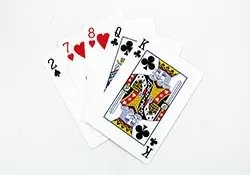
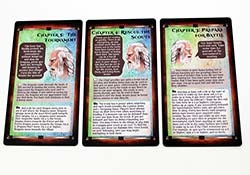
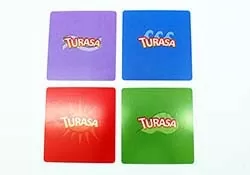
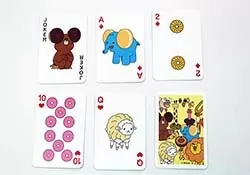
Standard Playing Card Sizes: A Complete Reference
The dimensions of modern playing cards have been shaped by centuries of use, manufacturing standards, and the practical needs of different games. The most widely recognized card sizes trace back to the United States Playing Card Company (USPCC), founded in Cincinnati in 1867, whose Bicycle brand (introduced in 1885) established the benchmarks that the industry still follows today. In 2019, USPCC was acquired by Cartamundi, the world’s largest playing card manufacturer, which continues to uphold these standards.
The table below lists every common card size in both imperial and metric units, along with typical applications.
Card Dimension Reference Table
| Card Type | Inches | Millimeters | Common Uses |
|---|---|---|---|
| Poker (Standard) | 2.5 × 3.5 | 63.5 × 88.9 | Poker, custom card games, most tabletop games, trading cards |
| Bridge | 2.25 × 3.5 | 57.15 × 88.9 | Bridge, canasta, hand-heavy games |
| Tarot | 2.75 × 4.75 | 70 × 120 | Tarot decks, oracle cards, oversized game cards |
| Square | 2.5 × 2.5 | 63.5 × 63.5 | Grid-based games, children’s games, draw-pile mechanics |
| Mini | 1.65 × 2.5 | 42 × 63.5 | Board game components, resource cards, travel games |
| TCG (MTG / Pokémon) | 2.48 × 3.46 | 63 × 88 | Trading card games, collectible cards |
| Yu-Gi-Oh! (Small TCG) | 2.32 × 3.39 | 59 × 86 | Yu-Gi-Oh!, Cardfight!! Vanguard, Japanese TCGs |
| Jumbo Index | 3.5 × 5.0 | 89 × 127 | Oversized display, accessibility, children’s games |
Note: The poker size closely corresponds to ISO 216 B8 (62 × 88 mm), the international paper standard. Cartamundi’s official technical specifications list poker cards at 63 × 88 mm and bridge cards at 56 × 87 mm.
How Playing Card Sizes Became Standardized
Playing cards arrived in Europe in the late 14th century, likely from Mamluk Egypt via trade routes, and the earliest confirmed European reference dates to a 1377 manuscript. For centuries, card dimensions varied wildly depending on the region and the printer. French card makers settled on the suit system we use today — hearts, diamonds, clubs, and spades — in the late 15th century, but sizes remained unstandardized.
It was the rise of industrial card manufacturing in the 19th century that created the dimensions we know today. When USPCC began mass-producing cards in 1881, the company settled on two standard sizes to serve the two most popular American card games: poker size (2.5 × 3.5 inches) for games where players fan a moderate hand, and bridge size (2.25 × 3.5 inches) for bridge and canasta, where players need to hold and read 13 or more cards at once. The narrower bridge card made this practical.
These dimensions have since been adopted worldwide. Every major manufacturer — including Cartamundi (Belgium), Angel Playing Cards (Japan), and TMCARDS (China) — produces poker and bridge sizes to the same specifications, give or take a fraction of a millimeter in manufacturing tolerance.
Which Card Size Should You Choose?
The right card size depends on your game’s mechanics, your target audience, and how the cards will be handled during play. Here are practical guidelines:
Choose poker size (2.5 × 3.5″) if:
- Players hold 7 or fewer cards at once
- Your cards have detailed artwork or large text
- You want maximum compatibility with standard tuck box packaging and retail shelves
- Your game is a standalone card game — this is the size players expect
Choose bridge size (2.25 × 3.5″) if:
- Players hold large hands (10+ cards)
- Your card information is simple enough to read at a narrower width
- You want a slimmer deck that fits easily in a pocket
Choose tarot size (2.75 × 4.75″) if:
- Your game uses richly illustrated cards meant to be displayed or examined closely
- You are printing a divination or oracle deck
- Your cards serve double duty as reference cards or player boards
Choose mini size (1.65 × 2.5″) if:
- Your cards are secondary components in a board game, not the main mechanic
- You need resource cards, event cards, or tokens that don’t require much reading
- You’re designing a compact travel game
For a detailed look at each of these sizes, including packaging options and die specifications, visit the individual pages linked in the grid above. If none of these standard sizes fit your project, see our 17 non-standard stocked die sizes or explore fully custom shapes including circles, hexagons, and die-cut silhouettes.
Trading Card Game (TCG) Dimensions
If you’re designing a collectible or trading card game, it helps to know the sizes established by the major TCG publishers, since your players will likely store your cards alongside these:
- Magic: The Gathering & Pokémon TCG: 63 × 88 mm (2.48 × 3.46″). Both games adopted this size because Wizards of the Coast originally published both properties. This is fractionally smaller than the USPCC poker size (63.5 × 88.9 mm), which means standard poker sleeves fit both.
- Yu-Gi-Oh!: 59 × 86 mm (2.32 × 3.39″). Noticeably smaller, following Japanese card game traditions where smaller card formats are common. Yu-Gi-Oh! cards require their own smaller “Japanese size” card sleeves.
If you want your TCG to be sleeve-compatible with MTG and Pokémon — which is a major convenience factor for players — design your cards at 63 × 88 mm. Standard card sleeves from manufacturers like Ultra Pro (66 × 91 mm) and Dragon Shield (66.5 × 92.5 mm) are designed to fit this size with a small buffer.
Technical Specifications for Print-Ready Card Files
No matter which card size you choose, these specifications apply to all custom card printing:
- Corner radius: The industry standard is 1/8″ (approximately 3–3.5 mm). Rounded corners reduce wear, prevent dog-earing, and make shuffling smoother. Our standard die-cutting process handles this automatically.
- Bleed area: Add 1/8″ (3 mm) of bleed on all sides. This extra area is trimmed away after cutting, so extend your background artwork to the bleed line.
- Safe zone: Keep all critical text and design elements at least 1/8″ (3 mm) inside the trim line. Index numbers, suit symbols, and card titles should be well within this safe area.
- Resolution: 300 DPI minimum at final print size. This is the standard for offset printing and ensures crisp text and clean line art.
- Color mode: Submit files in CMYK color mode. RGB files will be converted, which can cause color shifts — especially in blues, greens, and saturated reds.
- Card thickness: Standard playing card stock is 300–310 GSM (approximately 11–12 pt). We offer multiple finish options including linen texture, smooth matte, and gloss.
For complete file preparation guidelines for your card game project, see our card deck setup guides.
Regional Card Size Traditions
While poker and bridge sizes dominate globally, some regions maintain distinct card formats worth knowing — especially if you’re designing for an international audience:
- Japanese hanafuda: 54 × 32 mm — much smaller and thicker than Western cards, reflecting the traditional hanafuda (“flower card”) games dating to the Edo period. Nintendo began as a hanafuda manufacturer in 1889.
- German skat cards: 56 × 91 mm — slightly taller and narrower than poker cards, used in skat (Germany’s most popular card game).
- French tarot (Tarot Nouveau): 60 × 112 mm — narrower than American tarot cards, used for the French trick-taking game jeu de tarot, which uses a 78-card deck.
Frequently Asked Questions
What is the most common playing card size?
Poker size (2.5 × 3.5 inches / 63.5 × 88.9 mm) is the global standard. It’s used in the vast majority of card games, casinos, and custom card printing projects. If you’re unsure which size to choose, poker is the safest default.
What is the difference between poker size and bridge size?
Both are 3.5 inches tall, but bridge cards are 0.25 inches narrower (2.25″ vs 2.5″). Bridge size was developed for games where players hold large hands and need to fan many cards at once. See our poker size and individual card type pages for detailed comparisons.
Are custom card sizes more expensive?
If your dimensions match one of our 17 stocked non-standard die sizes, there’s no additional cost. Fully custom sizes or shapes require a new die to be manufactured, which adds approximately $500 for international offset orders. See our custom shape page for details.
What size sleeves do I need for my cards?
Card sleeves are typically 2.5–3.5 mm larger than the card on each dimension. For poker-size and MTG/Pokémon cards, use “standard” sleeves (66 × 91 mm). For Yu-Gi-Oh! and other Japanese-size cards, use “small” or “Japanese size” sleeves (62 × 89 mm). For tarot-sized cards, look for “oversized” or “tarot” sleeves.
What is the minimum order quantity for custom cards?
Our minimum order for custom card printing is 500 units. Offset printing delivers the best per-unit cost at higher quantities. View sample pricing or get an instant quote for your specific card size and count.
Learn More
On our site:
- Playing Card Stock — paper types, thickness, and how they affect card feel
- Card Finish Types & Styles — linen, smooth, gloss, and matte options
- Card Deck File Setup Guide — how to prepare your artwork for printing
- Card Game Production — the full manufacturing process from prepress to delivery
- Card Game Industry Standards — conventions for deck size, card count, and packaging
- Offset Printing Glossary — definitions for bleed, CMYK, die-cutting, and other terms used on this page
External references:
- Cartamundi Technical Specifications — official card dimension templates from the world’s largest card manufacturer
- United States Playing Card Company (Wikipedia) — history of the company that standardized poker and bridge card sizes
- The International Playing Card Society — academic society for the study of playing cards, publishers of The Playing-Card journal
- ISO 216 Paper Sizes (Wikipedia) — the international standard that includes the B8 size, which closely matches poker card dimensions
Ready to Print Your Card Game?
Our online calculator lets you configure your exact card dimensions, stock, finish, and packaging — and get an instant price. We print poker, tarot, mini, square, and fully custom sizes.
Get Your Quote