Design A Pop-Up Book
PrintNinja recommends keeping the following standards in mind when you design a pop-up book.
Pop-up books are a great tool to get young children interested in reading – with their special features and interactivity, they are almost a mix between a toy and a book. They sit alongside our children’s book printing and board book printing services as durable, kid-friendly formats. There are many different paper engineering techniques needed to create pop-ups: flaps, pull tabs, glue dots, valley folds, mountain folds and more. Even with the variety of pop-up formations these books share similar specifications in order to make the pop-ups pop: the pages within the book need to be thick enough to support the pop-up structure. This is why we recommend 10pt cover paper for the inside paper of your book.
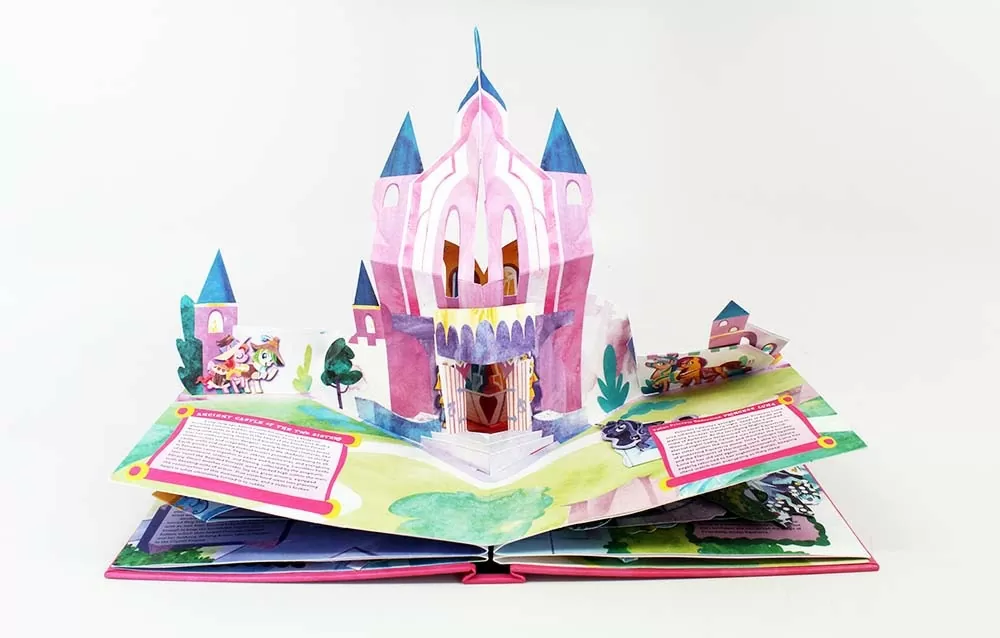
Pop-Up Book Design
-
- Binding: Case bound (hardcover)
- Size: No standard size, photo shows 8 inches x 8 inches
- Cover Paper: Hardcover
- Cover Finish: Gloss lamination
- Inside Paper: 10pt cover uncoated
Interior paper has to be thick so it can hold pop-up forms.
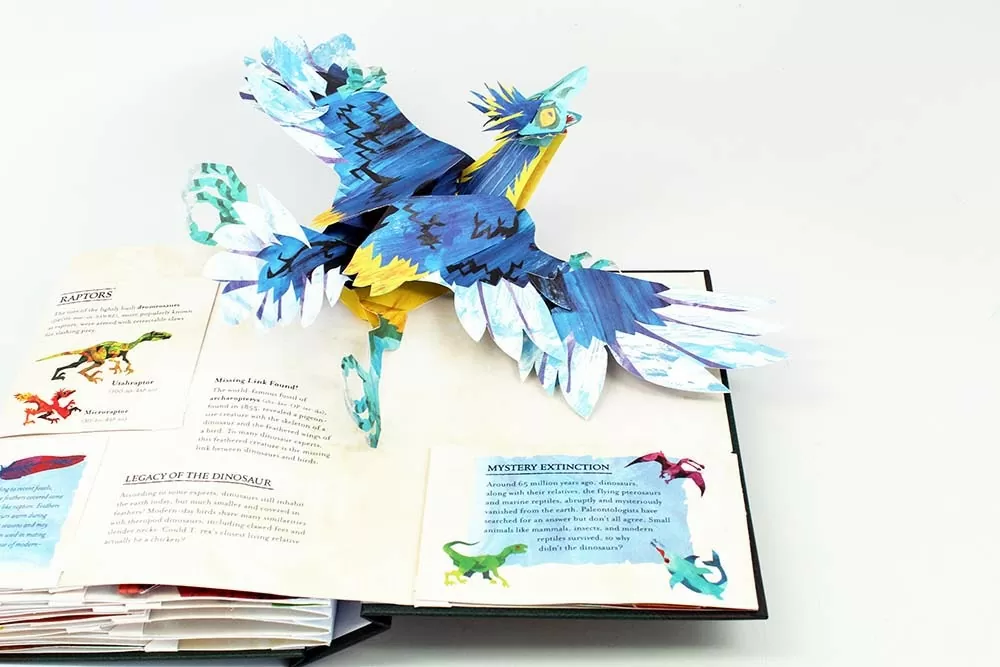
-
- Binding: Case bound (hardcover)
- Size: No standard size, photo shows 7.5 inches x 9.5 inches
- Cover Paper: Hardcover
- Cover Finish: Matte lamination
- Inside Paper: 10pt cover uncoated
Interior paper has to be thick so it can hold pop-up forms.
For more info on the pop-up book ordering process, check out our visual guide below!
A Brief History of Pop-Up Books
Pop-up books as we know them emerged in the 18th and 19th centuries. The German illustrator Lothar Meggendorfer (1847–1925) revolutionized the form by creating mechanisms where a single pull tab could activate multiple movements simultaneously using iron-riveted paper linkages. His innovations were so influential that the Movable Book Society – the international organization dedicated to pop-up and movable book artistry – awards its highest honor, the biennial Meggendorfer Prize, in his name.
The Smithsonian actually held a wonderful exhibition called “Paper Engineering: Fold, Pull, Pop & Turn” at the National Museum of American History that documented this history across more than 50 works spanning from 1570 to the present day, showing how movable books were originally developed to teach anatomy, astronomy, and mathematics. Anatomical books with layered flaps — called “fugitive sheets” — allowed medical students to peel back layers of the human body as early as the 16th century.
Today, contemporary paper engineers like Robert Sabuda (called “the king of pop-ups” by The New York Times) and Matthew Reinhart have pushed the form to extraordinary complexity, with single spreads containing dozens of interlocking mechanisms.
Pop-Up Book Printing: What You Need to Know
Probably the first and foremost thing to note about pop-up books is that they are not cheap to manufacture, and they often require consulting a paper engineer. We get a lot of outreach from people excited to get started with their pop-up book only to end up very disappointed that the costs are so high and they need to consult an outside party. As big appreciators of the form, we feel you and we wish that weren’t the case. If you decide to press on though (and we absolutely encourage you to!) here’s some essential info that can help you get started.
Pop-up books combine paper engineering with traditional bookbinding to create interactive, three-dimensional reading experiences. Whether you are designing a children’s book, an art piece, or a promotional item, understanding the printing requirements will help you create a better finished product.
Common Pop-Up Mechanisms
- V-Fold (Tent Fold): The most basic pop-up. A piece of paper is folded and glued to both pages so it rises when the book opens. Great for beginners and the foundation of more complex designs.
- Parallel Fold: Creates a flat platform that rises parallel to the page surface. Used for stages, buildings, and scenes where you need a horizontal surface.
- Pull Tabs: A strip attached to a moving element. The reader pulls the tab to animate part of the illustration — a technique perfected by Meggendorfer in the 1880s using riveted paper linkages.
- Flaps and Doors: Hinged elements that open to reveal hidden content underneath. One of the oldest movable book techniques, used in anatomical texts since the 1500s.
- Wheel (Volvelle): A rotating disc that reveals different images or text as you turn it. The oldest known movable mechanism in books, dating to the 13th century.
- Multi-Layer Scenes: Several V-folds or parallel folds stacked at different depths to create a theatrical diorama effect. Requires careful planning of fold angles and paper clearances.
Paper Requirements for Pop-Up Books
Pop-up mechanisms need thick, stiff paper to hold their shape. We recommend 10pt cover stock (uncoated) for interior pages. Thinner paper will not support the pop-up structures and will bend or collapse over time. The cover is typically a case bound (hardcover) binding for durability.
Uncoated paper is strongly preferred for pop-up interiors because it accepts glue better than coated stock — a critical consideration since every pop-up element is hand-glued to the page. Coated (gloss or matte) paper resists adhesive bonding and can cause mechanisms to detach with use.
Paper grain direction also matters: folding against the grain creates rough, imprecise folds, while folding with the grain produces clean, consistent creases. Discuss grain direction with your printer during the prepress stage.
Design Tips
- Keep pop-ups at least 0.25 inches from the page edges to avoid trimming issues
- Test your mechanisms with paper prototypes before submitting final files — paper engineering is one area where a physical mock-up is irreplaceable
- Consider the grain direction of your paper, as it affects how cleanly pieces fold
- Limit the number of pop-up elements per spread to avoid bulk when the book is closed — thick books are harder to bind and more expensive to ship
- Include a flat dummy (mock-up) with your print files so the bindery team understands assembly
- Use die-cut shapes rather than straight cuts when your pop-up elements have curves or complex silhouettes
- Design your pop-up elements as separate artboards in your file, clearly labeled with fold lines, cut lines, and glue areas — see our bleed and trim setup guide for general dieline principles
Cost and Timeline Considerations
Pop-up books are among the most labor-intensive printed products because every mechanism must be hand-assembled. Unlike standard bookbinding, which is fully automated, pop-up assembly requires skilled workers to fold, glue, and position each element by hand.
What to expect:
- Cost: Pop-up books typically cost 2–4× more per unit than a standard hardcover of the same page count, depending on the number and complexity of mechanisms. Simple flap books are on the lower end; multi-mechanism spreads with pull tabs and layered scenes are on the higher end.
- Timeline: 8–12 weeks from file approval to delivery, compared to 4–6 weeks for standard hardcovers. The hand-assembly phase adds the most time.
- Minimum order: 500 units is our typical minimum for pop-up books, though this can vary with complexity.
- Prototyping: We strongly recommend ordering a prototype or proof before committing to a full run. Pop-up mechanisms behave differently in person than on screen — a fold angle that looks right in your design software may not work mechanically.
To manage costs, consider mixing pop-up and flat spreads. A book with 4 pop-up spreads and 4 flat illustrated spreads delivers the “wow” factor while keeping production costs reasonable.
Frequently Asked Questions About Pop-Up Book Printing
How much does it cost to print a pop-up book?
Pop-up book printing costs vary based on the number of pop-up mechanisms, page count, and quantity ordered. Pop-ups require hand assembly, which increases the per-unit cost compared to standard books. For a ballpark, expect pop-up books to cost 2-4x more per unit than a standard hardcover of the same page count. Contact us to discuss pricing for your specific project.
What is the minimum order for pop-up books?
Our minimum order quantity for pop-up books is typically 500 units, though this can vary depending on the complexity of your design. Offset printing becomes more cost-effective at higher quantities.
What file format do I need for pop-up book printing?
Submit your files as print-ready PDFs with 0.125-inch bleed on all sides. Each pop-up element should be on its own artboard with clear dielines showing cut, fold, and glue areas. Include an assembly guide or reference dummy. See our file setup guides for general dieline principles.
How long does it take to print a pop-up book?
Pop-up books typically take 8-12 weeks from file approval to delivery, depending on complexity. The hand-assembly process adds time compared to standard book printing. Rush options may be available for simpler designs.
Can I print a pop-up book with fewer than 500 copies?
For smaller quantities, we recommend starting with a prototype run to test your mechanisms before committing to a full print run. Contact us to discuss options for short-run pop-up projects.
What age group are pop-up books suitable for?
Pop-up books work for all ages, but the mechanism complexity should match the audience. Simple flap books and sturdy pull tabs work well for children ages 3+. Delicate multi-layer pop-ups are better suited for older children and adults. For very young readers (0–3), consider a board book format instead, which offers durability without fragile moving parts.
References & Further Reading
On our site:
- Case Binding (Hardcover) — the standard binding for pop-up books
- Paper Weight Guide — understanding GSM, caliper, and cover stock options
- Die Cutting — how custom shapes are cut for pop-up elements
- Board Books — a durable alternative for very young readers (ages 0–3)
- Hardcover Children’s Books — standard (non-pop-up) children’s book printing
- Embossing & Debossing — add tactile texture to your pop-up book covers
- Offset Printing Glossary — definitions for bleed, dieline, case binding, and other terms
External references:
- Smithsonian: “Paper Engineering: Fold, Pull, Pop & Turn” — landmark exhibition documenting 500 years of movable book history at the National Museum of American History
- Smithsonian Libraries: Walk-Through of Pop-Up/Movable Book History — visual timeline from volvelles to contemporary paper engineering
- The Movable Book Society — Meggendorfer Prize — the international organization for pop-up book artistry and its biennial award for paper engineering excellence
- University of Saskatchewan: ArchBook — Volvelles — academic resource on the history and construction of rotating paper mechanisms
- Getty Museum: Decoding the Medieval Volvelle — scholarly article on the earliest movable paper mechanisms
Ready to Print Your Pop-Up Book?
Pop-up books require custom quoting due to their hand-assembled construction. Tell us about your project and our team will guide you from prototype through production.
Contact Us