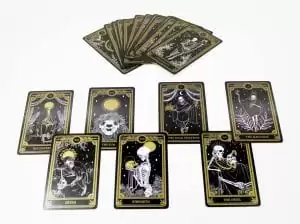
Tarot cards were initially used in Europe to play games, but have been used for fortune telling and divination since the 18th century. Decks have 78 cards that fall into two categories: major arcana and minor arcana. Major arcana consist of 22 cards without suits, and minor arcana have four suits with 14 cards each. By applying the SVU model (Simplicity, Variability, and Uniqueness), we can understand what makes this game so successful and learn how to make custom tarot cards.
Simplicity: though becoming a tarot expert requires time and study, it is a relatively easy hobby to pick up. All that’s required is a tarot deck, with information on how to get started available for free on the internet.
Variability: tarot is incredibly versatile: there are a ton of “spreads” (card arrangements) you can use to tell fortunes. If you’re not interested in that aspect of tarot, you can also use it to play games like jeu de tarot, which is the second most popular card game in France.
Uniqueness: tarot separates itself from other card games by being not only a game and hobby, but also a collectors item. There are so many decks with different types of art that it makes it hard to stop after buying just one deck. If you’re an artist, making a tarot deck is a novel way to sell your art in a way that is both aesthetically pleasing and functional.
Understanding Tarot Deck Structure
A traditional tarot deck follows a structure that dates back to 15th-century Italy. Understanding this structure is important when planning your custom deck, because it determines your total card count, artwork requirements, and production cost.
Major Arcana (22 cards): These are the iconic cards most people associate with tarot — The Fool, The Magician, The High Priestess, Death, The Tower, and so on. Each card is unique, meaning you’ll need 22 distinct illustrations. Many creators start here because these cards carry the most visual impact and are frequently featured in marketing materials.
Minor Arcana (56 cards): Organized into four suits (traditionally Wands, Cups, Swords, and Pentacles), each containing 14 cards: Ace through 10, plus four court cards (Page, Knight, Queen, King). Some creators fully illustrate all 56 cards, while others use a pip-style design for the numbered cards to reduce the illustration workload.
Additional cards: Most published decks also include a title card, an instruction card, and one or two blank replacement cards, bringing the total to 80–82 cards. When planning your deck with PrintNinja, factor these extras into your card count — they’re printed on the same press sheet as your game cards, so adding a few extras has minimal cost impact.
Cardstock Options for Tarot
The cardstock you choose directly affects how your tarot deck feels in the hand — and for tarot, the tactile experience matters. Readers shuffle constantly, and collectors judge quality by feel. Here are the options we offer:
Blue Core Standard (280 GSM): The industry standard for playing cards and tarot decks. The blue-dyed inner layer prevents light from passing through the card, which is essential for tarot where seeing the next card would undermine the reading experience. This is what most professional tarot publishers use, and it’s what we recommend for most projects. Meets the opacity standards used by major card manufacturers like the United States Playing Card Company.
Black Core (300/310 GSM): The premium option. A thicker card with a black-dyed core that provides even better opacity than blue core. The extra weight gives the deck a luxurious, substantial feel that collectors appreciate. If you’re positioning your deck as a premium or limited-edition product, black core is worth the investment.
Linen Texture: Available on both blue core and standard cardstock, linen texture adds a crosshatch pattern to the card surface. This gives the cards a distinctive feel and also helps hide minor scratches and fingerprints over time — a practical benefit for decks that get heavy use. Many tarot creators choose linen for its blend of durability and aesthetics.
Coreless Standard: A budget-friendly option without the colored inner core. Suitable for prototype runs or decks where opacity isn’t critical, but we generally don’t recommend this for finished tarot products since light bleed-through can be an issue.
Finish and Lamination
Your finish affects both the look and the longevity of your deck. All of our cards receive lamination on both sides to protect the printing and improve durability — the choice is in what type.
Gloss lamination makes colors pop and gives the deck a vibrant, polished appearance. It’s the most popular choice for decks with rich, detailed artwork. Gloss cards slide smoothly against each other, which makes shuffling easy.
Matte lamination produces a softer, more muted look that many tarot creators prefer for its understated elegance. Matte cards have slightly more grip, which some readers prefer for laying out spreads. Matte also reduces glare, making the artwork easier to read in bright lighting.
Spot UV can be applied selectively over a matte-laminated card to highlight specific design elements — for example, making the gold details on a tarot card glossy while the background stays matte. This creates a striking contrast that elevates the perceived value of the deck. Learn more about spot UV printing.
Packaging Your Tarot Deck
Tarot decks are larger than standard playing card decks (2.75″ × 4.75″ vs. 2.5″ × 3.5″), and with 78+ cards, the deck is thick. This means standard poker tuck boxes won’t work — you need packaging specifically sized for tarot.
Tarot tuck box: A custom-printed tuck box sized to fit a 78-card tarot deck. This is the most economical packaging option and works well for decks at any price point. We print full-color artwork on the exterior, and you can add finishing options like foil stamping or embossing to the box as well.
Two-piece rigid box: A lift-top box with a separate lid and base, similar to what you’d see on high-end retail products. This is the premium packaging choice for tarot — it protects the cards better, displays beautifully, and signals quality to the buyer. Many Kickstarter-funded tarot decks use two-piece boxes because backers expect a premium unboxing experience.
Magnetic closure box: A rigid box with an integrated magnetic flap. This provides the premium feel of a two-piece box with the convenience of a single-piece design. It’s an excellent middle ground between tuck boxes and rigid boxes.
Shrink wrap: All packaging options can be shrink wrapped for retail-ready presentation and to protect the cards during shipping. We recommend shrink wrap for any deck that will be sold through retail channels or fulfilled through Amazon.
Companion Guidebook
Many tarot decks ship with a companion guidebook — a small booklet explaining the meaning of each card, suggested spreads, and the artist’s creative vision. If you’re planning to include one, PrintNinja can produce the guidebook alongside your cards for streamlined production and shipping.
Common guidebook specs for tarot decks:
Size: typically 3″ × 5″ or 4″ × 6″ to fit inside the packaging
Page count: 40–120 pages depending on detail level
Binding: saddle-stitched (stapled) for thinner guides, or perfect-bound for comprehensive guides
Paper: 128 GSM matte art paper is the most popular choice
If your guidebook exceeds 80 pages, consider perfect binding for a clean spine. For shorter guides, saddle-stitching keeps costs down and fits neatly inside most box types.
File Setup for Tarot Cards
Tarot cards use a finished size of 2.75″ × 4.75″ (70 mm × 121 mm). When preparing your artwork files, keep these specifications in mind:
Bleed: Add 3 mm (0.118″) of bleed on all sides, extending your artwork beyond the cut line. This ensures no white edges appear after trimming.
Safe zone: Keep all critical text and design elements at least 5 mm (0.197″) from the cut edge. Card trimming has a standard manufacturing tolerance of ±1 mm per the ISO 19593-1 print data exchange standard, so this margin protects your content.
Resolution: 300 DPI minimum in CMYK color mode. Tarot artwork is often viewed at close range, so high resolution is especially important.
File format: Submit print-ready PDFs with each card face as a separate page. Name your files clearly (e.g., “01-The-Fool.pdf”, “02-The-Magician.pdf”) to avoid production errors.
Card backs: If all cards share the same back design, you only need to provide one back artwork file. If your deck uses multiple back designs, clearly label which backs correspond to which cards.
While you can customize your tarot deck with a number of specialty options like foil stamping, metallic ink, or linen texture, here are the components you need for a basic deck.
78 tarot size (2.75″ x 4.75″) cards, 280 GSM blue core standard with gloss finish
2 piece box – gloss lamination
To find out how much it would cost, head over to our custom card game calculator and plug in the components to calculate the price of your custom tarot cards.
Since PrintNinja specializes in medium to large quantity orders, we have a minimum order quantity (MOQ) of 500 units. To help you make a decision on the types of materials to use in your card game, we recommend ordering a sample pack: this is a best way to experience the varieties of cards you can order for your custom card game.
We want both you and your wallet to be happy with your order, so we’ve provided some card game cost reduction strategies that will get you the perfect balance between features and value.
Tarot Deck Specs at a Glance
Feature
Options
Standard card count
78 cards (22 major + 56 minor arcana), plus optional title/instruction/replacement cards
The cost depends on card count, cardstock, finish, packaging, and order quantity. A standard 78-card tarot deck with blue core cardstock, gloss lamination, and a tuck box typically runs a few dollars per unit at quantities of 500+. Adding premium options like black core cardstock, spot UV, or a two-piece box increases the per-unit price. Get an instant quote with our online calculator.
Can I print a non-standard number of cards?
Yes. While the traditional tarot deck has 78 cards, many indie creators design oracle decks, affirmation decks, or other card-based products with anywhere from 30 to 120+ cards. Our pricing calculator supports any card count, and our team can advise on the most cost-effective way to configure your deck.
What’s the difference between tarot and oracle cards?
Tarot decks follow a defined structure: 78 cards divided into major and minor arcana with specific suits and court cards. Oracle decks are freeform — they can have any number of cards with any theme or structure the creator chooses. Both are printed using the same process and materials. If you’re creating an oracle deck, the same tarot card size (2.75″ × 4.75″) is the most popular choice, but you can use any of our custom card sizes.
Should I include a guidebook with my deck?
For tarot decks, a guidebook is strongly recommended — buyers expect it. For oracle decks, it depends on your concept. If each card has a specific meaning or prompt, a guidebook adds value. PrintNinja can print your guidebook alongside your cards and package everything together, keeping production simple and shipping costs low.
How do I protect my tarot deck artwork?
Copyright protection applies automatically to your original artwork. For additional protection, you can register your designs with the U.S. Copyright Office. If you’re working with a freelance illustrator, make sure your contract includes a work-for-hire clause or an explicit transfer of copyright. PrintNinja does not claim any rights to your artwork — your files are your property.
We've created a custom card game pricing calculator just for card games so you can explore printing choices, shipping methods, and accurate order prices for your project. You can also customize just about anything, from game card sizes to specialty options like embossing and debossing.