Novels
PrintNinja recommends keeping the following guidelines in line when you design a novel.
The quintessential printing project, novels have evolved considerably since the first printing press. The page size tends to vary depending on the publisher but can usually be found in the range of 5.5″ x 8.5″ to 6″ x 9″ (please see our page size guide for measuring hardcover books). Mass Market Paperback books, which are usually around 4.25″ x 6.75″, are also a popular option. The paper stock also tends to be the thinnest possible for the binding type to keep costs down, since there isn’t a lot of printing on each page compared to full color art books. As with any book format, though, the specifications are not set in stone and you will always find books with their own unique size and feel – something to keep in mind for when you design a novel and print it with us.
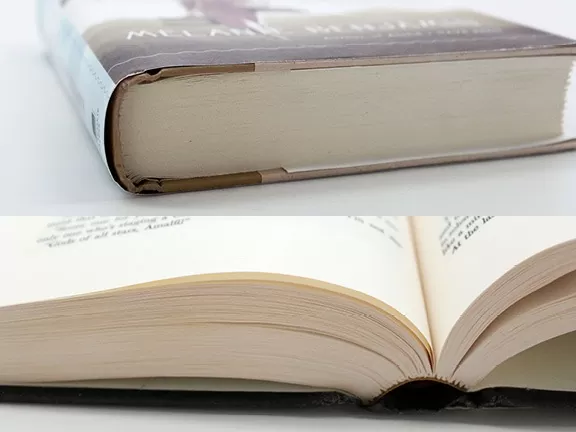
Hardcover Novel Standards
- Binding: Case bound (hardcover)
- Size: 6 inches x 9 inches
- Cover Paper: Hardcover
- Cover Finish: Gloss or matte lamination
- Inside Paper: 70lb text uncoated
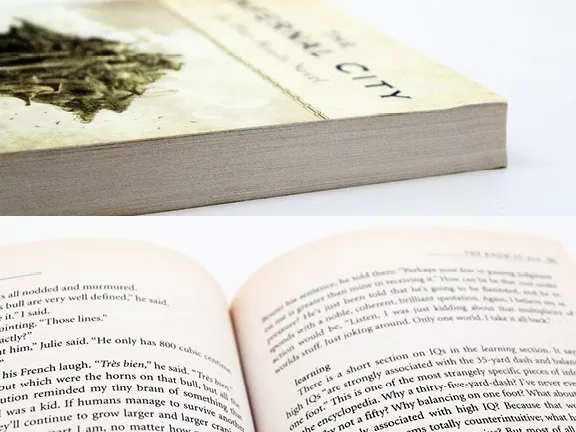
Softcover Novel Standards
- Binding: Perfect (softcover)
- Size: varies, usually around 5.5 inches x 8.5 inches or 6 inches x 9 inches
- Cover Paper: 10pt cover gloss or matte
- Cover Finish: Gloss or matte lamination
- Inside Paper: 55lb text uncoated
Standard Novel Trim Sizes
Novel dimensions aren’t arbitrary — they’ve been shaped by printing press sheet sizes, binding equipment, and retail shelving standards. Here are the most common formats:
| Format | Trim Size | Common Use |
|---|---|---|
| Mass Market Paperback | 4.25″ x 6.75″ | Genre fiction (romance, mystery, sci-fi). Compact and inexpensive. Fits in a back pocket. |
| Trade Paperback (small) | 5.5″ x 8.5″ | Literary fiction, poetry, memoirs. The most popular self-publishing size. |
| Trade Paperback (large) | 6″ x 9″ | Non-fiction, business books, longer novels. Standard for hardcover fiction as well. |
| Royal | 6.14″ x 9.21″ | UK trade standard — slightly larger than the U.S. 6×9. |
| A5 | 5.83″ x 8.27″ | International standard (ISO 216). Common in Europe and Asia. |
The mass market paperback size was standardized in the 1930s by Pocket Books and later codified by the mass market distribution system — the books needed to fit standard wire spinner racks in drugstores and airports. Trade paperbacks, introduced at scale in the 1950s, use larger trim sizes that better match hardcover dimensions.
Paper Stock for Novels
Novel interiors are almost always printed on uncoated stock. Unlike art books or photo books, novels don’t need the color fidelity of coated paper — and uncoated stock is easier on the eyes for sustained reading, with less glare under direct light.
| Paper | Weight | Characteristics | Best For |
|---|---|---|---|
| White uncoated | 50–60 lb text | Bright white, thin, lightweight | Short novels, poetry, keeping shipping weight down |
| White uncoated | 70 lb text | Good opacity, moderate thickness | Standard novels (most common choice) |
| Cream/natural uncoated | 50–70 lb text | Warm, off-white tone; reduced eye strain | Literary fiction, long-form reading, premium feel |
Cream (also called “natural” or “antique”) paper is the preferred choice for literary fiction because the warm tone reduces contrast between ink and paper, creating less eye fatigue during long reading sessions. Most major publishers — Penguin Random House, HarperCollins, Simon & Schuster — use cream stock for their fiction lines.
Paper opacity matters especially for novels. Per TAPPI T 425, opacity above 90% prevents text from showing through the reverse side. At 50 lb weight, some show-through is inevitable; 70 lb provides a good balance of opacity and cost.
Typography and Interior Layout
Professional novel typesetting follows well-established conventions. While these aren’t rigid standards, they represent best practices followed by major publishers:
- Font size: 10–12 pt for body text (11 pt is the most common)
- Leading (line spacing): 120–145% of font size (e.g., 11 pt text with 14 pt leading)
- Margins: 0.5″–0.75″ on top, outside, and bottom; 0.625″–0.875″ on the gutter (inside) to account for binding
- Line length: 60–75 characters per line — the range recommended by typographer Matthew Butterick and supported by readability research
- Font choice: Serif fonts dominate (Garamond, Caslon, Bembo, Minion Pro). Sans-serif is occasionally used for chapter headings but rarely for body text in print fiction.
Robert Bringhurst’s The Elements of Typographic Style is considered the definitive reference for book typography. For digital typesetting, most independent publishers use Adobe InDesign — the industry standard page layout application — though open-source alternatives like Scribus and typesetting systems like LaTeX (with the memoir class) are also capable of producing press-ready novel interiors.
Binding for Novels
| Binding | Page Count Range | Spine Printable? | Best For |
|---|---|---|---|
| Perfect bound (softcover) | 48–800 pages | Yes | Trade paperbacks, mass market. The most cost-effective option. |
| Case bound (hardcover) | 32–1000+ pages | Yes (foil stamp or printed jacket) | First editions, premium editions, library copies. |
| Smyth sewn + case bound | 64–1000+ pages | Yes | Premium hardcovers. Signatures are sewn together before casing, creating the strongest and most durable binding. |
For hardcover novels, the cover is typically a printed dust jacket wrapped around cloth or printed case boards. The dust jacket is printed on 100 lb gloss text with either gloss or matte lamination. Beneath the jacket, the case boards can be covered with cloth, printed paper, or a combination (quarter-bound: cloth spine with printed boards).
The Book Manufacturers’ Institute (BMI) publishes the Manufacturing Standards and Specifications for Textbooks (MSST), which is the primary U.S. reference for binding durability grades. While designed for textbooks, these standards are widely used to benchmark binding quality for trade books as well. The international equivalent is ISO 11800:1998, which classifies binding strength into usage categories from “limited use” to “frequent use.”
Cover Design Specifications
Your novel’s cover needs to work at multiple scales — full size on a bookstore shelf, thumbnail size on Amazon, and everything in between. Key specifications:
- Bleed: 0.125″ (3 mm) on all sides
- Safe area: Keep all text 0.25″ (6 mm) inside the trim line
- Spine width: Calculated from page count × paper thickness. Your print provider will supply the exact measurement — don’t guess.
- Resolution: 300 DPI minimum in CMYK color mode
- Barcode area: Reserve a clear space on the back cover (typically lower right) for the ISBN barcode