Instructions and Rule Booklets
PrintNinja recommends you keep the following guidelines in mind in order to design an instruction manual.
A game cannot exist without standardized rules for a group of players to follow. There are many ways to display instructions with your game, the most popular being a booklet, as seen below. For board games, you could also print the instructions on the inside of the box. A cost-effective option for card games is to print the rules on your tuck box or on an extra card included in your deck.
If you’re interested in reading more about custom game printing, be sure to check out our custom board game hub and our custom card game hub. These parts of our site contain all the information you need to know about creating a board game or a card game – beyond just the standards listed here, these hubs also contain detailed information on all the types of materials and packaging types we offer for your game. We’ve also analyzed board and card games to figure out what makes them work – and how you can apply these principals to your custom game. Check it out!
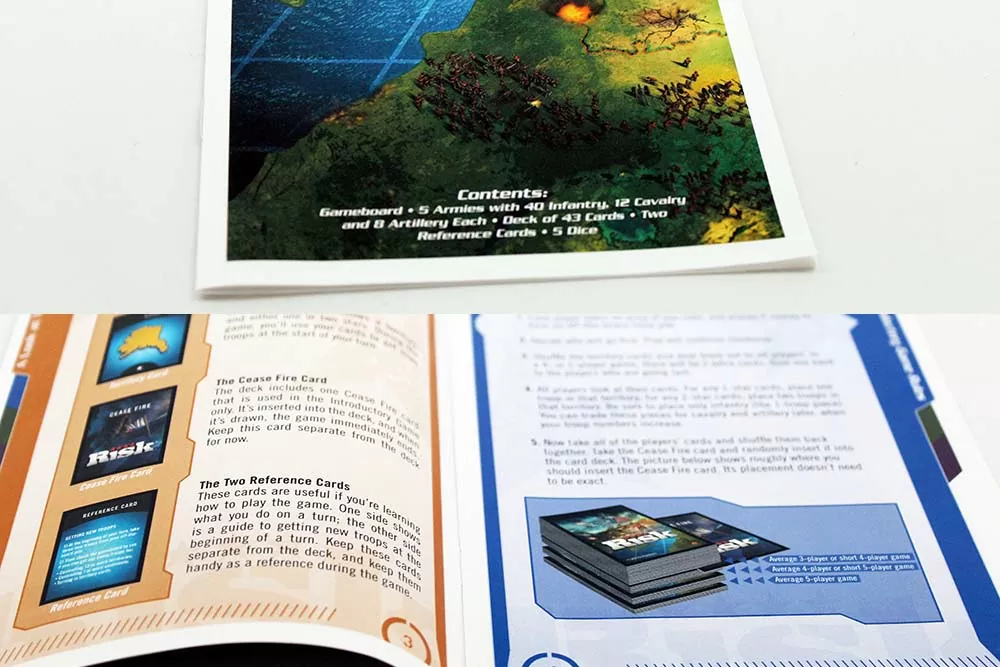
Instruction Manual Design Standards
Rule Booklet
- Size: No standard size, photo shows 6 inches x 9 inches
- Cover Paper Weight: No standard weight, photo shows 70lb text
- Interior Paper Weight: No standard weight, photo shows 70lb text
- Finish: Gloss
- Binding: Saddle-stitched
- Interior Page Count: No standard count, but page counts need to be a multiple of 4
Instruction Format Options
Depending on your game’s complexity and packaging, there are several ways to deliver rules to your players:
| Format | Best For | Page Count | Cost |
|---|---|---|---|
| Saddle-stitched booklet | Medium-complexity games (8–48 pages of rules) | Must be a multiple of 4 | Moderate |
| Folded rules sheet | Simple games with 1–2 pages of rules | 1 sheet, folded | Low |
| Accordion fold (Z-fold) | Quick-reference rules, party games | 4–8 panels | Low |
| Inside box lid | Very simple games or as a quick-start guide | N/A — printed on packaging | Included with box |
| Extra cards in deck | Card games with minimal rules | 1–4 cards | Minimal |
| Perfect-bound book | Complex strategy games (48+ pages) | Any count | Higher |
Rulebook Sizes
While there’s no single industry standard for rulebook dimensions, your booklet size should be determined by what fits inside your game’s packaging:
| Game Packaging | Common Rulebook Size | Notes |
|---|---|---|
| Tuck box | 2.5″ x 3.5″ (poker card size) | Must fit inside the tuck box with the cards |
| Small two-piece box | 5″ x 7″ or 5.5″ x 8.5″ | Fold to fit if needed |
| Standard game box (10″ x 10″) | 6″ x 9″ or 8″ x 8″ | Lays flat on top of components |
| Large game box (12″ x 12″+) | 8.5″ x 11″ or 8.5″ x 8.5″ | Room for longer, more detailed rules |
Paper and Finish for Rulebooks
Rulebooks take a lot of abuse — they get folded, bent, passed around the table, and stuffed back into the box. Paper and finish choices should prioritize durability and readability:
- 70–80 lb text, gloss coated — The most common choice. Gloss coating adds durability and makes full-color diagrams look sharp. The coating also resists fingerprints and minor spills — important for a document that gets handled during game night.
- 80–100 lb text, matte coated — Reduced glare makes extended reading more comfortable. Good for text-heavy rulebooks (20+ pages) where players will spend time studying the rules.
- Covers — For saddle-stitched booklets, a slightly heavier cover stock (80–100 lb text or even card stock) helps the booklet hold its shape in the box and resist dog-earing.
For the cover finish, aqueous coating provides good scuff resistance without the added cost and rigidity of full lamination. If your rulebook will see heavy use (convention demos, game café copies), matte or gloss lamination on the cover adds significant longevity.
Rulebook Design Best Practices
A well-designed rulebook can make or break a player’s first experience with your game. The Game Manufacturers Association (GAMA) and numerous game design communities have converged on these layout principles:
Structure
- Start with the goal — Tell players how to win before explaining the mechanisms. This gives context to every rule that follows.
- Component list with images — A visual inventory of every piece in the box, with labels. This helps players verify they have everything and learn component names before reading rules.
- Setup section with diagram — A bird’s-eye illustration of the table layout at game start. Use callouts and arrows to show where each component goes.
- Turn structure — Break each turn into numbered phases. Use headers, icons, or color coding to distinguish phases visually.
- Examples of play — Walk through 1–2 turns of actual gameplay with specific card names, board positions, and player decisions. This is the single most effective way to reduce rules confusion.
- Quick reference — Put a turn summary or key rules on the back cover for mid-game lookups.
Typography and Readability
- Font size: 9–11 pt body text minimum. Rules in smaller type frustrate players and are especially inaccessible for older gamers. The WCAG 2.1 accessibility guidelines recommend a minimum of 9 pt for printed body text.
- Column width: 45–75 characters per line for optimal readability — consistent with the research-backed recommendations in Robert Bringhurst’s The Elements of Typographic Style.
- Visual hierarchy: Use bold for keywords and game terms, color for phase headers, and icons for recurring actions (draw, discard, move). Consistent visual language reduces lookup time during play.
- White space: Don’t cram rules to save pages. Adequate margins (0.5″+ minimum) and paragraph spacing improve comprehension and make the book feel less intimidating.
Folded Rules Sheets
For simpler games, a single folded sheet can replace a booklet entirely. Common fold patterns:
- Single fold (4 panels) — A standard letter-size sheet folded in half. 4 printable surfaces at 8.5″ x 5.5″ each.
- Tri-fold / Z-fold (6 panels) — A letter-size sheet folded into thirds. Good for party games and card games with straightforward rules.
- Gate fold (4 panels, different widths) — Two flaps fold inward to meet in the center. Creates a dramatic reveal when opened — sometimes used for setup diagrams.
Folded sheets are printed on heavier stock than booklet interiors — typically 80–100 lb text or even cover stock — because they’re handled as standalone documents without the protection of a bound cover.
Printing Rules on Packaging
Many card games and party games print rules directly on the tuck box interior or on the inside of the box lid. This eliminates a separate component and ensures the rules are never lost. The trade-off is limited space — you’ll have room for perhaps 200–400 words depending on font size and box dimensions, so this approach only works for games with very simple rules.