Party Board Game
PrintNinja recommends keeping the following guidelines in mind when you design a party game.
It’s hard to define a party game, but you know it when you play it. They’re games that are meant to be played in large social gatherings for entertainment – we know it sounds like most games! Some common characteristics are team-based play, easy for players to learn quickly, and a lot of player interaction with each other. Popular party games include Cranium, Taboo and Scattergories. Finishit, outlined below, shows common sizes, material and components found in party games.
If you’re interested in reading more about custom game printing, be sure to check out our custom board game hub and our custom card game hub. These parts of our site contain all the information you need to know about creating a board game or a card game – beyond just the standards listed here, these hubs also contain detailed information on all the types of materials and packaging types we offer for your game. We’ve also analyzed board and card games to figure out what makes them work – and how you can apply these principals to your custom game. Check it out!
For a video breakdown of Party Game Industry Standards, check out our visual guide below. Otherwise, read on!
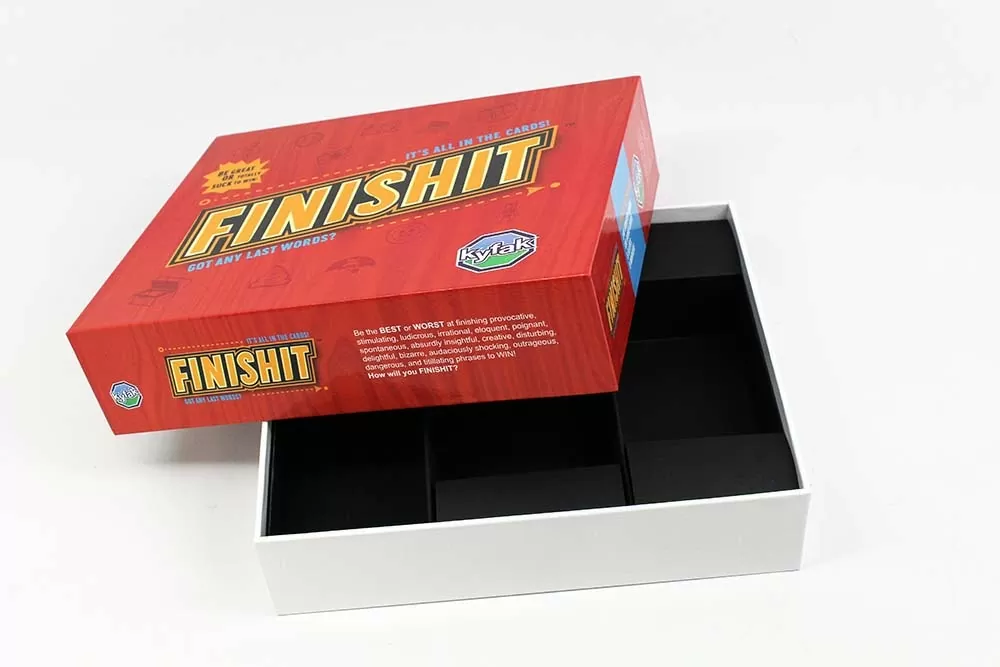
Party Card Game Design
Two-Piece Box
- 7 inches x 8 inches x 2 inches
- 2 mm high density paperboard
- Full CMYK
- Organizing Insert:
- 20pt coated 1-side gloss cardstock
- 3 compartments
- Black
- Packaging: Shrinkwrap
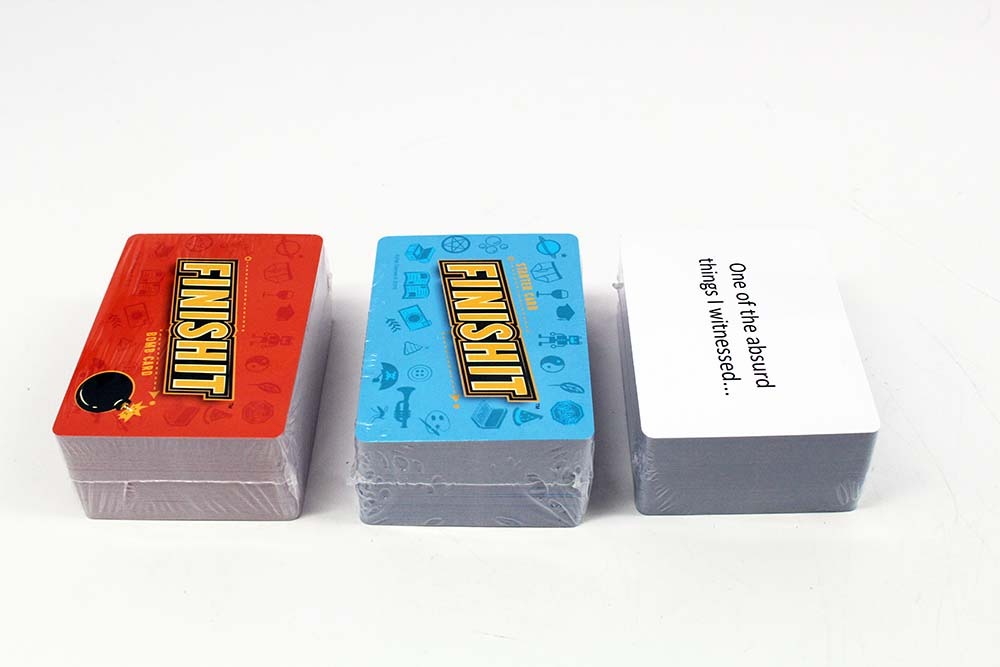
Playing Cards
- 360 poker cards, 2.5 inches x 3.5 inches
- Divided into 3 decks of 120
- 280 gsm Blue Core
- Gloss Varnish
- Full CMYK
- Packaging: Shrinkwrap
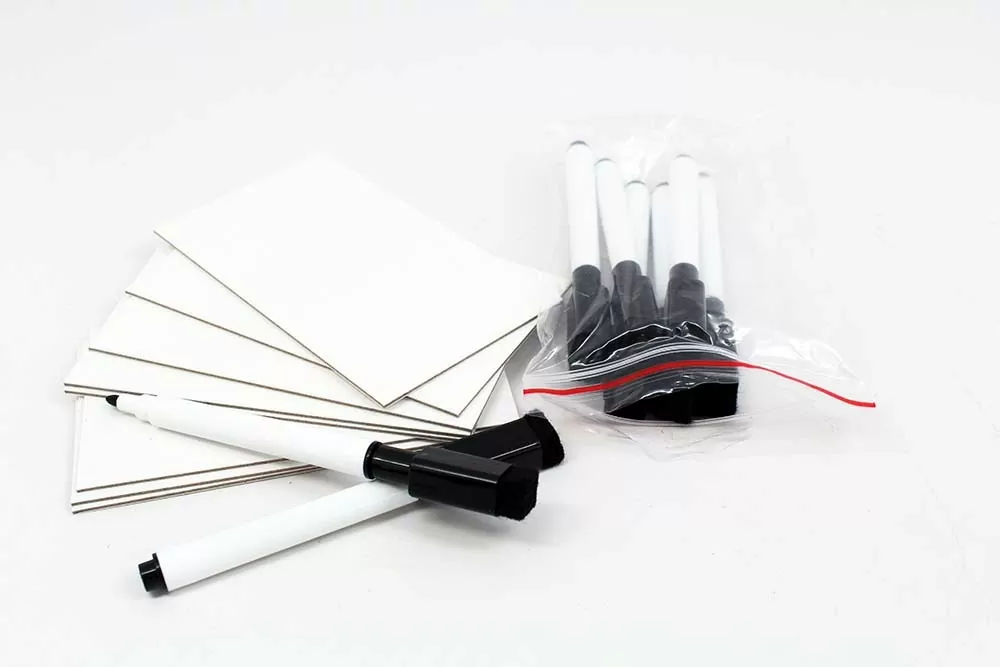
Dry Erase Boards & Markers
- 8 tiles, 2.75 inches x 4.750 inches
- 1.5mm high density paperboard
- Double lamination
- Gloss
- 8 black dry erase markers with eraser tips
- Packaging: Plastic bag
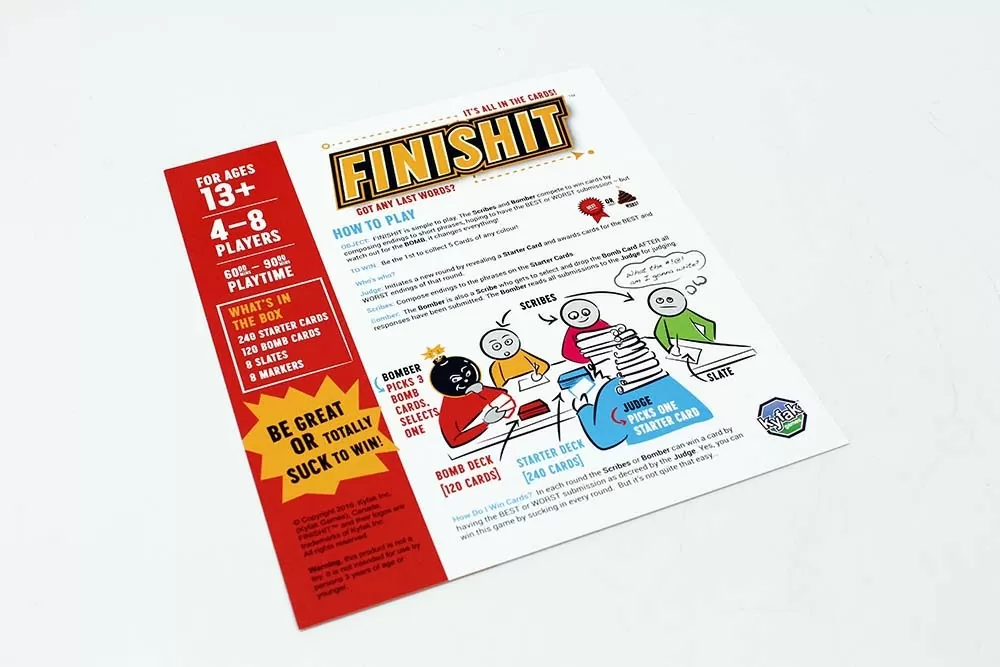
One Sheet Instructions
- 7 inches x 8 inches
- 10pt cover gloss varnish paper
- One flat sheet
- Full CMYK
What Makes a Party Game a Party Game?
Party games occupy a specific niche in tabletop gaming — they’re designed for accessibility, social interaction, and laughter over deep strategy. The Game Manufacturers Association (GAMA) classifies party games as their own category, and retailers typically merchandise them separately from strategy and hobby games.
Key design characteristics that define the category:
| Characteristic | Party Game Standard | Why It Matters |
|---|---|---|
| Player count | 4–12+ players | Must accommodate large groups without bogging down |
| Learn time | Under 5 minutes | New players should be able to join mid-game without confusion |
| Play time | 15–45 minutes | Short enough to replay or switch games in one gathering |
| Downtime | Minimal | Players should rarely sit idle — simultaneous play or fast turns |
| Complexity | Low (1–2 on BGG weight scale) | Accessible to non-gamers and casual players |
Common Party Game Components
Party games tend to use a consistent set of components, chosen for quick setup and intuitive play:
Cards
Cards are the backbone of most party games. Prompt-and-response games (like Cards Against Humanity, Apples to Apples, and What Do You Meme?) rely on large decks — often 300–600+ cards — to provide replayability. Card stock is typically 280–300 gsm blue core with a gloss or linen finish. The ISO 216 B8 format (62 x 88 mm) closely matches the standard poker card size (2.5″ x 3.5″) used by most party games.
Timers
Many party games include a timer component — sand timers are the most common because they’re inexpensive, visually engaging, and don’t require batteries. Standard sand timer durations for party games are 30 seconds, 1 minute, and 2 minutes.
Dry Erase Components
Drawing and writing games (Telestrations, Pictionary, A Fake Artist Goes to New York) use dry-erase boards or coated tiles. These are made from high-density paperboard with double gloss lamination — the smooth, sealed surface allows dry-erase markers to wipe clean. The lamination must be applied on both sides to prevent warping from moisture differential.
Dice
Custom dice appear in many party games, used for random prompts, category selection, or scoring. Standard dice sizes are 12mm, 16mm (the most common), and 19mm. Custom engraved or printed dice use acrylic or resin with paint-filled recessed faces.
Packaging Considerations for Party Games
Party games face unique packaging challenges because they need to:
- Survive rough handling — Party games travel to gatherings, get tossed in backpacks, and stack in closets. A two-piece box with 2mm high-density paperboard provides the structural integrity needed.
- Organize many components — Games with 300+ cards and multiple component types need internal organization. Custom organizing inserts (also called form trays) divide the box interior into compartments, keeping components separated and secure during transport.
- Communicate quickly on retail shelves — Party game boxes need to convey the game’s premise, player count, and play time at a glance. The SPIEL Essen convention (the world’s largest board game fair) has established informal conventions: player count, age, and play time are typically displayed as icons on the front or side of the box.
The Party Game Market
Party games represent one of the fastest-growing segments in tabletop gaming. According to industry data tracked by ICv2 (the trade publication for the hobby games industry), party games consistently rank among the top-selling categories in both hobby retail and mass market channels.
The modern party game boom was catalyzed by Cards Against Humanity (2011), which demonstrated that a simple card game could achieve mainstream cultural penetration through crowdfunding and word-of-mouth. Its success spawned an entire subgenre of prompt-response party games and proved that Kickstarter was a viable launch platform for tabletop games.
For designers entering the party game space, BoardGameGeek (BGG) — the definitive community database for tabletop games — maintains a party game category with thousands of entries, searchable by rank, weight, and player count. Studying top-rated party games on BGG is one of the best ways to understand what works in the category.