Modern Single Issue Comic Book Industry Standards
PrintNinja recommends following these guidelines to design a modern comic book.
Comic books have changed a lot since the Golden Age, both in the look of the printing as well as the feel of the paper. Modern printing techniques allow for a much wider range of color and saturation, and current comics have taken advantage of this by adding a glossy finish to the pages to allow the colors to pop more. This coating also helps preserve the comic’s quality for a longer period of time. Ultimately the feel of your comic is entirely up to you, but here are some recommendations if you wish to match the comics you see at your local comic shop.
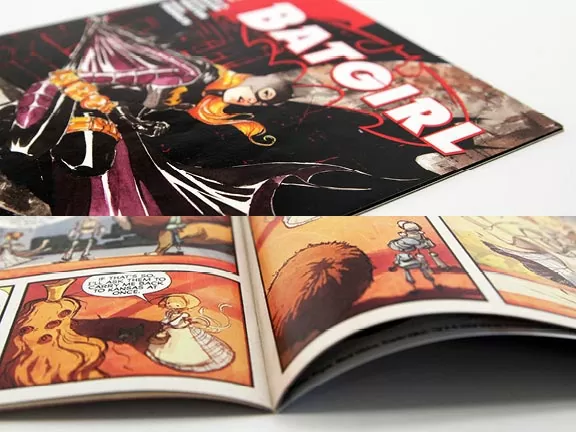
Design a Modern Comic Book
Modern Comics
- Binding: Saddle-stitched
- Size: 6.625 inches x 10.25 inches
- Cover Paper: 85lb text gloss
- Cover Finish: Gloss varnish
- Inside Paper: 55lb gloss (DC/Marvel) or 70lb gloss (Image)
A Brief History of Comic Book Formats
The modern comic book format traces back to 1933, when Max Gaines and Harry Wildenberg at Eastern Color Printing produced Funnies on Parade — a collection of reprinted newspaper strips folded to half-tabloid size. This established the standard comic book dimensions that persisted for decades.
The Diamond Comic Distributors trade dress specifications define the modern standard single issue at 6.625″ x 10.25″ (168 x 260 mm), though historically comics were slightly larger — Golden Age issues measured approximately 7.75″ x 10.5″.
Standard Comic Book Sizes
| Format | Trim Size | Typical Page Count | Binding |
|---|---|---|---|
| Single issue (floppy) | 6.625″ x 10.25″ | 24–32 pages | Saddle-stitched |
| Digest | 5.5″ x 8.5″ | 80–160 pages | Perfect bound |
| Trade paperback | 6.625″ x 10.25″ | 96–200 pages | Perfect bound |
| Manga (tankōbon) | 5″ x 7.5″ | 180–220 pages | Perfect bound |
| European album (BD) | 8.5″ x 11.25″ | 48–64 pages | Hardcover |
| Omnibus | 6.75″ x 10.25″ | 400–1000+ pages | Hardcover, sewn |
Paper Stock for Comics
Paper choice has a dramatic effect on how your comic looks and feels. The two main categories:
Glossy coated stock is the modern standard. DC and Marvel use 55 lb gloss text for interiors, while publishers like Image Comics use slightly heavier 70 lb gloss. The coating creates a smooth surface that reproduces fine detail and saturated color with minimal dot gain (ink spread). This is measured per ISO 12647-2:2013, the international standard for offset lithographic printing on coated paper.
Uncoated (newsprint-style) stock recreates the classic Golden/Silver Age look with softer colors and visible dot patterns. Modern “newsprint-style” paper isn’t true newsprint — it’s typically 50–60 lb uncoated text stock that mimics the aesthetic without the yellowing and brittleness of actual newsprint. This is popular for indie comics going for a vintage or underground feel.
Color and Printing
Modern comics are printed in full CMYK process color, but this wasn’t always the case. Until the mid-1980s, comics used a limited palette system developed by Chemical Color — just 64 colors created from combinations of 25%, 50%, and 100% screens of cyan, magenta, and yellow. Colorists worked on hand-separated overlays, and the results were printed on cheap newsprint with significant dot gain.
The shift to digital coloring began in the early 1990s, with Shattered Image #1 (1996) among the first major titles colored entirely digitally. Today, industry-standard tools include Clip Studio Paint (the successor to Manga Studio) and Adobe Photoshop, with files prepared at 400 DPI for line art or 300 DPI for painted/fully rendered work.
Artwork Setup
When preparing your comic book files for print, follow these specifications:
- Bleed: Add 0.125″ (3mm) bleed on all four sides beyond the trim line
- Safe area: Keep all critical text and art at least 0.25″ (6mm) inside the trim line
- Resolution: 300 DPI minimum for color art; 400 DPI or higher for black-and-white line art to keep edges sharp
- Color mode: CMYK (not RGB) — convert before submission to avoid color shifts
- File format: PDF/X-1a or press-quality PDF with fonts embedded
The PDF/X-1a standard (defined in ISO 15930-4) is the industry-standard file format for offset print production because it embeds all fonts, flattens transparency, and requires CMYK-only color — eliminating the most common prepress errors.
Binding Considerations
Single-issue comics are almost universally saddle-stitched — two wire staples through the spine fold. This method is fast, cost-effective, and works well for page counts up to about 64 pages. Beyond that, the spine becomes too thick for staples to hold reliably, and you’ll want to switch to perfect binding (which also gives you a flat spine for title printing).
For premium collected editions, Smyth-sewn (section-sewn) binding is the gold standard. Signatures are individually sewn and then glued into a hardcover case, creating a book that lays nearly flat and can withstand decades of re-reading. This is the binding method used for most hardcover omnibus and absolute editions.
Eager to learn more? Explore further into the world of comic book printing and gain valuable insights into prevalent industry standards by checking out our comprehensive visual guide: