French Fold Cover Setup Guide
Because a single sheet of paper is wrapped around the rest of your pages to create your cover, french fold covers should be created as a single spread.
What Is a French Fold Cover?
A french fold (also called a gatefold cover or french flap) is a cover format where the front and back covers each have an extended flap that folds inward, tucking behind the first and last pages of the book. The result is a softcover book with the visual weight and premium feel of a dust-jacketed hardcover — at a fraction of the cost.
French fold covers are widely used in literary fiction, art books, poetry collections, and high-end magazines. You’ll see them frequently on titles from publishers like Graywolf Press, New Directions, and Coffee House Press, where the flaps carry author bios, blurbs, and series information — just like a hardcover dust jacket. The Independent Book Publishers Association (IBPA) considers french folds one of the key design features that help indie titles compete visually with major publisher releases on bookstore shelves.
The technique gets its name from french folding in paper engineering — a fold where a sheet is folded in half with the printed side out, creating a double-thick panel. In bookbinding, the term has evolved to describe any cover with folded-in flaps. The format is especially common in European publishing — particularly in France (unsurprisingly) and Germany, where the term Klappenbroschur (flap paperback) is standard industry vocabulary.
French Fold Cover Template
- The “Page Height” measurement in the guide below should be the same height as the inside pages of your book.
- PERFECT BOUND PROJECTS: The “Page Width” measurement should be your interior page width x 2 + your selected french fold width x 2 + spine width.
SADDLE STITCH PROJECTS: The “Page Width” measurement should be your interior page width x 2 + your selected french fold width x 2. - To calculate the width of your spine, see our online spine calculator.
- Finally, as with your inside pages, you should include 0.125 inches of bleed around the edge of your design that will be trimmed off. Also make sure to keep all important text and graphics 0.125 inches away from the trim line since softcovers, like all offset printing, exhibit minute variance in their production.
If you are using a design program that does not allow you to specify the bleed, as with Adobe Photoshop, you will need to add the bleed into your page calculations:
PERFECT BOUND PROJECT
Page Height = interior page height + .25″
Page Width = interior page width x 2 + your selected french fold width x 2 + spine width + .25″.
SADDLE STITCH PROJECT
Page Height = interior page height + .25″
Page Width = interior page width x 2 + your selected french fold width x 2 + .25″.

French Fold Flap Width
The flap width is a design choice, but common dimensions include:
| Flap Width | Use Case | Notes |
|---|---|---|
| 2.5″–3″ | Standard — author bio and blurbs | The most common size. Enough room for a short bio, photo, and 2–3 blurb quotes. |
| 3.5″–4″ | Extended — series info, detailed synopsis | Popular with literary publishers. Provides ample space for design elements. |
| Full page width | Wraparound — poster or map reveal | The flap unfolds to reveal a full illustration, map, or poster. Dramatic but requires careful paper selection to avoid bulk. |
Important Design Considerations
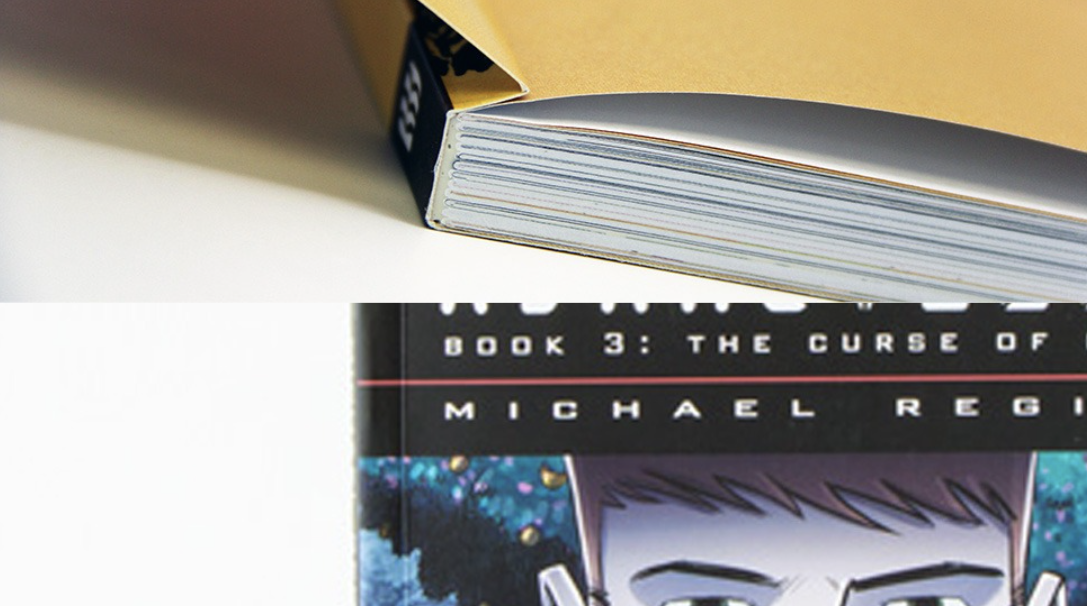
Because the book block is glued into the cover, perfect bound books have 10 millimeters of area on their inside covers that will be glued to the first and last inside page. This means that all artwork on the inside covers, the first inside page, and the last inside page should be kept at least .40″ away from the spine.
Additionally, we score the front and back cover to allow them to open without a rough crease.
Paper Stock for French Fold Covers
The cover stock for a french fold needs to be heavy enough to hold its shape when folded, but flexible enough to fold cleanly without cracking. Recommended stocks:
- 12–14 pt C1S (Coated One Side) — The most common choice. The coated side faces outward for vibrant color and scuff resistance; the uncoated interior is ideal for printing flap content (author bio, blurbs) with a softer, more readable finish.
- 10 pt cover stock — Works for thinner books where a bulky cover would feel disproportionate. Folds cleanly but provides less rigidity.
- Soft-touch lamination — A popular premium finish for french fold covers. The velvety texture makes the book feel luxurious and differentiates it from standard softcovers on a bookstore shelf.
The fold itself must be scored before folding — meaning a crease line is pressed into the stock with a steel rule die. Without scoring, the paper fibers will crack along the fold, especially on heavier stocks. Scoring follows the grain direction of the paper per TAPPI T 411, with cross-grain folds requiring deeper scoring to prevent cracking. The Book Manufacturers’ Institute (BMI) MSST specification covers scoring and folding tolerances for cover materials, and ISO 11800:1998 includes requirements for cover board flex resistance relevant to folded cover constructions.
When to Use a French Fold Cover
French folds are an excellent choice when you want:
- A premium look without hardcover cost — French folds add perceived value and shelf presence at a fraction of what case binding costs.
- Flap real estate — Space for author bios, blurbs, series lists, or promotional text that won’t fit on the back cover alone.
- Built-in bookmarks — Readers naturally use the front flap as a bookmark, which is a practical benefit that adds to the reading experience.
- Retail differentiation — On a bookstore shelf, french fold spines sit slightly wider than standard softcovers, making them more visible.
The main trade-off is cost: a french fold cover uses roughly 2.5–3x more paper than a standard softcover and requires additional folding and scoring operations. For high-volume trade publishing, the per-unit cost increase is modest; for short-run projects, the percentage increase is more significant.