Do I Need An ISBN?
Do I need an ISBN? It’s a question that we get all the time. For most people, the answer is “definitely.” A single International Standard Book Number is $125 (at the time of this writing) and is an excellent investment in your publishing future.
Basically, an ISBN is not required for face-to-face sales, sales on your own website, distribution to crowdfunding backers, etc. It is, however, required by bookstores, Amazon, book distributors like Diamond, Baker & Taylor, libraries, and so on. (Your friendly local comic book shop or local coffee shop might buy a few of your copies as a kind of community benefit.)
The ISBN (International Standard Book Number) is required for each version of your book: new editions, softcover and hardcover versions all need a unique identifier. The only place to purchase your own ISBN is www.bowker.com. Barcodes can be generated for free using this tool.
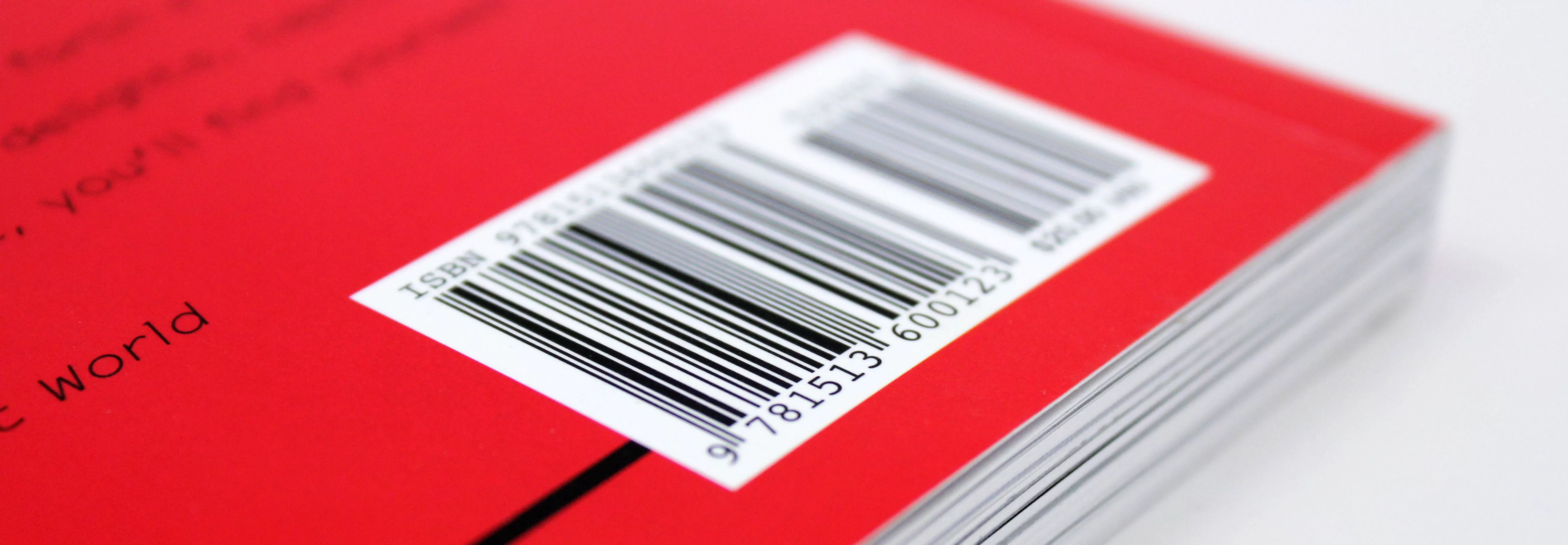
When designing your cover or dust jacket, you can put the barcode and International Standard Book Number wherever you want, so be sure to include them in your art when you submit your files. Just make sure it’s 300dpi and 100% black on a white background (ideally a vector PDF file). Otherwise, it may appear too blurry to scan.
If you have a hardcover book with a cloth or faux leather cover, you can opt to put the ISBN on a dust jacket or on a sticker on the outside of shrink wrap. (We’ve done both.)
Given the above, if you think that you want to give online distribution a try, the $125 fee is a small price to pay!
What Is an ISBN, Exactly?
The ISBN system was created in 1970 by the International ISBN Agency, based on a 9-digit Standard Book Number (SBN) system developed by British bookseller W.H. Smith in 1966. The system is governed by ISO 2108:2017, maintained by the International Organization for Standardization.
A modern ISBN is a 13-digit number (the format switched from 10 to 13 digits in 2007) structured as five groups:
| Element | Example | Meaning |
|---|---|---|
| Prefix | 978 | EAN “Bookland” prefix (978 or 979) |
| Registration group | 1 | Country/language area (1 = English-speaking) |
| Registrant | 93456 | Publisher identifier (assigned by Bowker) |
| Publication | 78 | Specific edition/format of the title |
| Check digit | 3 | Calculated validation digit |
The 13-digit ISBN is identical in structure to an EAN-13 barcode (the European Article Number system managed by GS1), which is why ISBN barcodes can be scanned by any standard retail barcode reader.
When You Need an ISBN — and When You Don’t
| Distribution Channel | ISBN Required? | Notes |
|---|---|---|
| Amazon (print books) | Yes | Amazon will assign a free ASIN, but an ISBN is required for print listings |
| Barnes & Noble / bookstores | Yes | No bookstore will stock a title without an ISBN |
| Libraries | Yes | Library cataloging systems (MARC records) are built around ISBNs |
| Distributors (Ingram, Baker & Taylor) | Yes | Required for listing in Books in Print and distributor catalogs |
| Your own website | No | Direct sales don’t require an ISBN |
| Crowdfunding fulfillment | No | Kickstarter/BackerKit shipments are direct-to-consumer |
| Conventions/events | No | Face-to-face sales don’t require an ISBN |
| Amazon Kindle (ebook) | No | Amazon uses its own ASIN system for digital |
Where to Buy ISBNs
In the United States, Bowker (a division of ProQuest) is the exclusive ISBN agency — they are the only source for U.S.-based publisher ISBNs. Current pricing (as of 2025):
- 1 ISBN: $125
- 10 ISBNs: $295 ($29.50 each)
- 100 ISBNs: $575 ($5.75 each)
- 1,000 ISBNs: $1,500 ($1.50 each)
If you plan to publish more than one title — or if a single title will have multiple formats (hardcover, softcover, ebook) — buying in bulk saves significantly. Remember: each format requires its own ISBN. A hardcover edition and a softcover edition of the same book need two separate numbers.
Other countries have their own ISBN agencies. The International ISBN Agency maintains a complete directory. In many countries (UK, Canada, Australia), ISBNs are issued free of charge by government-affiliated agencies.
ISBNs vs. Other Identifiers
The publishing world uses several identification systems, and they serve different purposes:
- ISBN — Identifies a specific edition/format of a book. Governed by ISO 2108.
- ISSN — International Standard Serial Number. For periodicals (magazines, journals, ongoing comic series). Governed by ISO 3297. Free to obtain from the ISSN International Centre.
- LCCN — Library of Congress Control Number. Assigned free by the Library of Congress for cataloging purposes. Recommended alongside an ISBN if you want library placement.
- DOI — Digital Object Identifier. Used for academic and research publications. Governed by ISO 26324.
- UPC/EAN — Universal Product Code. Required for non-book retail products (board games, card games). Obtained from GS1 US.
Barcode Placement and Specifications
The ISBN barcode (technically an EAN-13 + EAN-5 supplement) should be placed on the back cover, lower right area, following GS1 symbol placement guidelines:
- Minimum size: 80% magnification (29.83 mm wide x 20.73 mm tall)
- Quiet zone: At least 3.63 mm of clear space on left and right sides of the barcode
- Color: Black bars on white background for maximum scanner readability. Dark bars on any light, solid background also work — but avoid placing barcodes on gradients, photos, or patterned backgrounds.
- Format: Vector PDF at 300+ DPI. Never scale a raster barcode image — it will blur and become unscannable.
The 5-digit supplement to the right of the main barcode encodes the suggested retail price. The first digit indicates currency (5 = USD, 6 = CAD), followed by the price in cents. For example, “51499” means $14.99 USD. If you don’t want to print a price, use “90000” (no price given).
Common ISBN Mistakes to Avoid
- Using a “free” ISBN from a self-publishing platform — Services like KDP, IngramSpark, and Lulu may offer free ISBNs, but they are listed as the publisher of record, not you. If you want your own imprint name in industry databases, purchase your own ISBN through Bowker.
- Reusing an ISBN for a revised edition — If you change more than 10% of the content, it’s considered a new edition and needs a new ISBN. Minor corrections (typo fixes, updated contact info) don’t require a new number.
- Assigning the same ISBN to different formats — Hardcover, softcover, and ebook editions each need their own ISBN. An audiobook version also needs a separate ISBN.